
Picture this. You ordered 5,000 units from an overseas factory. The inspector pulls 200 pieces, finds 16 small cosmetic flaws, and your lot is marked “fail”, even though every unit works. Who decided that 16 was too many? And why 200 pieces, not 100 or 500?
The answer is AQL sampling. It is the method most third-party inspections use to turn a handful of checked units into a pass or fail decision for the whole shipment. This guide explains how it works in plain language, with a worked example you can reuse on your own orders.
What does AQL mean?
AQL stands for acceptance quality limit. Older documents and many supplier contracts still use the earlier wording, “acceptable quality level”, and both mean the same thing in practice.
In simple terms, the AQL is the highest defect rate that you and your supplier agree is tolerable across a continuing run of shipments. You don’t choose a pass mark out of thin air. You pick an AQL for each type of defect, and a standard table converts that choice into hard numbers: how many units to inspect, and how many defects trigger a rejection.
Where the AQL rules come from
Most AQL inspections follow ISO 2859-1, the international standard for lot-by-lot inspection by attributes. Its American counterpart is ANSI/ASQ Z1.4. Both grew out of an older military standard, MIL-STD-105E, which they have long since replaced in commercial use.
For buyers and exporters in the Gulf, there is a regional angle too. The Gulf Standardization Organization publishes its own adopted edition, GSO ISO 2859-1:2016, so the same logic sits behind many regional requirements.
One note on currency: ISO released a new edition of the standard in 2026. If your contract names a specific edition, confirm which one applies before relying on any table you find online.
Why inspectors sample instead of checking everything
A full check of every unit sounds safer, but in practice it is rarely sensible:
• It takes far longer and costs far more.
• Inspectors lose focus after hours of repetitive checking, so a 100% check is not as thorough as it sounds.
• A properly drawn random sample gives you most of the information at a fraction of the effort.
A full check still has its place. It makes sense for very high-value goods, for tiny quantities, or as a corrective step when one supplier keeps failing sample-based inspections.
How AQL sampling works in five steps
1. Confirm the lot size. This is the total quantity being inspected, not a single carton.
2. Choose an inspection level. This decides how large the sample is relative to the lot.
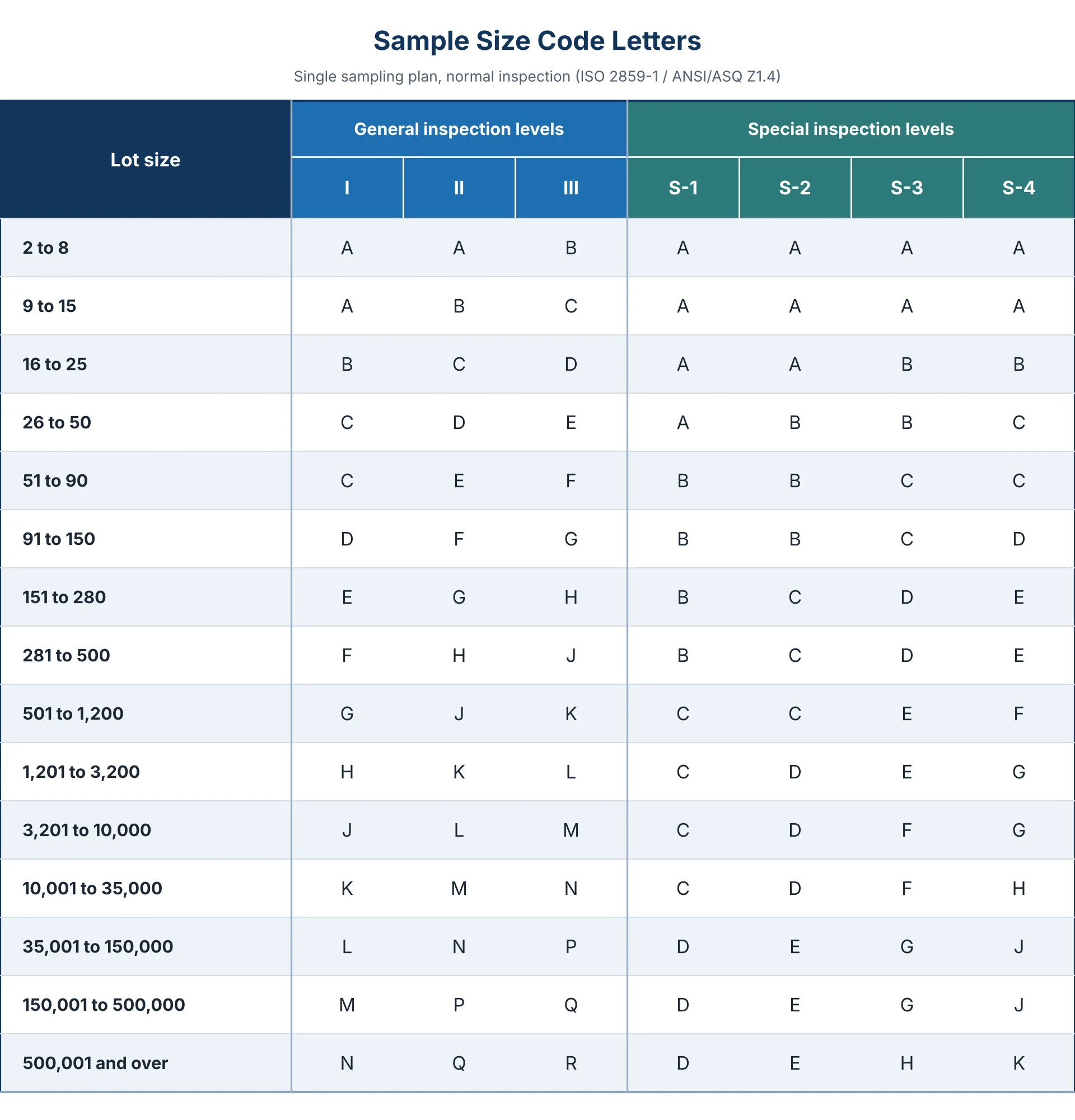
3. Look up the sample size code letter. The standard’s first table matches lot size and inspection level to a letter.
4. Read off the sample size. The second table converts that letter into a number of units to inspect.
5. Apply the accept and reject numbers. For each defect class, the table shows the highest defect count you can accept and the count at which the lot is rejected.
Inspection levels: how much to check
The standard offers seven levels. General levels I, II and III suit ordinary visual and functional checks. Special levels S-1 to S-4 use much smaller samples and carry a higher risk of missing problems.
| Level | When it is typically used |
|---|---|
| General I | A trusted supplier with a clean record, accepting a lower level of discrimination |
| General II | The usual default for consumer and commercial goods |
| General III | A supplier with recent quality problems, high-value goods or small lots |
| Special S-1 to S-4 | Destructive or time-consuming tests, and quick checks such as container loading supervision |
Here is how much the level changes the workload on a 5,000-unit order:
| Level | I | II | III | S-1 | S-2 | S-3 | S-4 |
|---|---|---|---|---|---|---|---|
| Units inspected | 80 | 200 | 315 | 5 | 8 | 20 | 32 |
A common confusion is worth clearing up here. The inspection level changes the sample size. It does not change the AQL. The two are separate decisions.
A word of caution on Level I. Choosing it by default to save inspection time lowers your chance of catching a bad lot. Use it only when a supplier has earned it.
Sample size at General Level II
At the default level, the sample grows with the lot, but not in proportion:
| Lot size | Code letter | Units inspected |
|---|---|---|
| 1,201 to 3,200 | K | 125 |
| 3,201 to 10,000 | L | 200 |
| 10,001 to 35,000 | M | 315 |
| 35,001 to 150,000 | N | 500 |
Notice that a 40,000-unit lot does not need eight times the sample of a 5,000-unit lot. This is why the old rule of thumb, “just check 10% of the order”, is both wasteful on big orders and too thin on small ones.
Critical, major and minor defects
AQL works by sorting every defect into a class and judging each class on its own.
| Class | What it means | Examples | Common AQL |
|---|---|---|---|
| Critical | Could harm a user or breach a regulation | Exposed live wiring, a sharp edge on a child’s product, a missing mandatory warning label | 0 (no tolerance) |
| Major | Likely to cause a complaint, return or loss of function | Product won’t power on, missing component, wrong colour or size | 2.5 |
| Minor | Cosmetic or small flaws that don’t affect use | A faint scuff, a loose thread, slight shade variation | 4.0 |
For general consumer goods, 0 / 2.5 / 4.0 is the most widely used combination. It is a starting point, not a rule. Buyers of children’s products, electronics or premium goods often tighten the major and minor limits, and buyers of low-cost promotional items sometimes relax the minor limit.
Published guidance on “typical” AQLs by industry varies from one source to another, so treat any such list as an example. The AQL that matters is the one written into your purchase agreement.
Reading the accept and reject numbers
Once you know the sample size, the table gives two numbers for each AQL: Ac (accept) and Re (reject). If the defects found are at or below Ac, that class passes. If they reach Re, it fails.
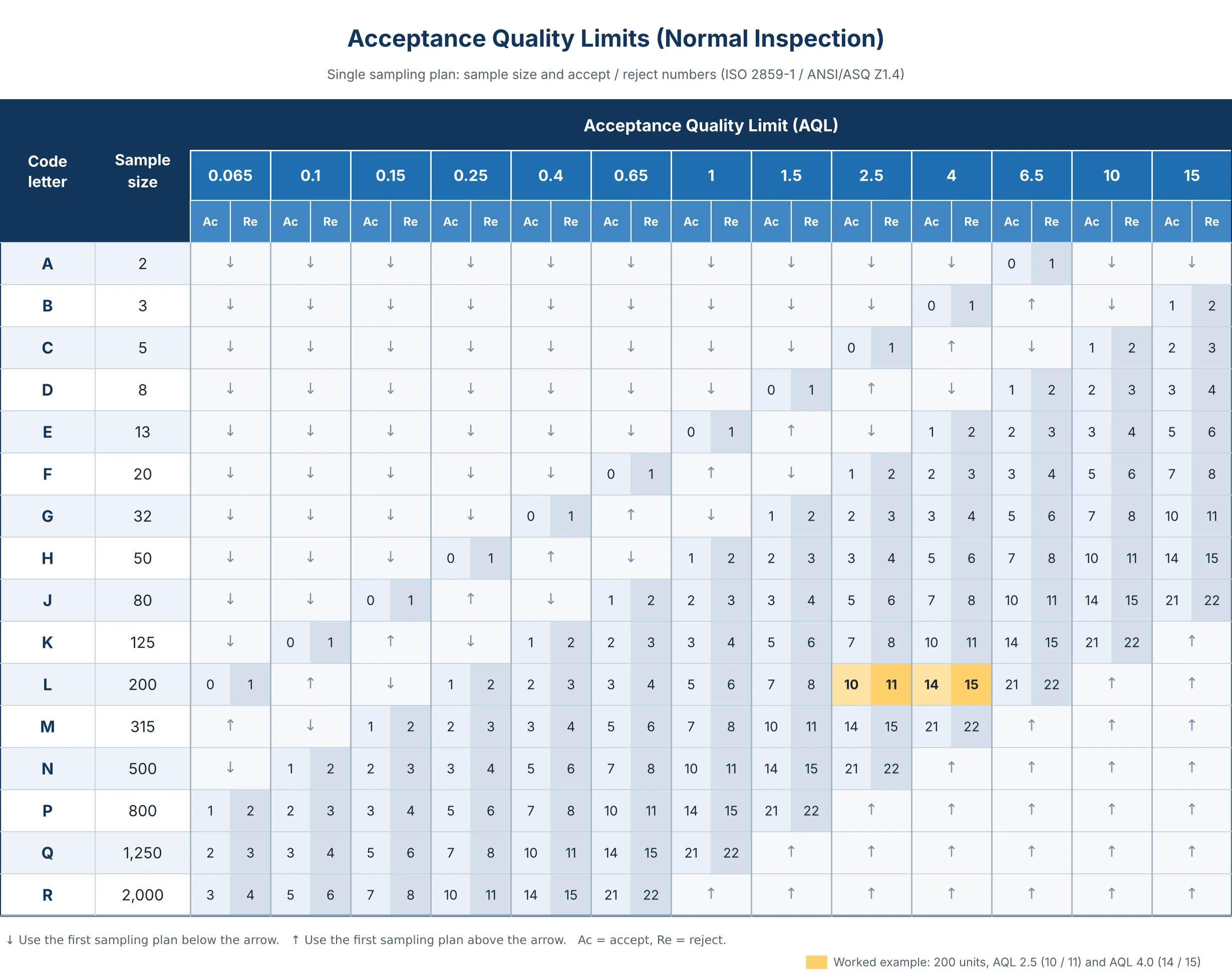
The chart below shows the sample size and the accept and reject numbers for every code letter and AQL. Find your code letter in the first column, then read across to your AQL.
How to read the chart:
- Find your code letter in the first column. The next column gives the sample size.
- Move across to the AQL you set for that defect class, for example 2.5 for major defects.
- Read the two numbers in that cell. Ac is the most defects you can accept, and Re is the point where the lot is rejected.
- If you land on an arrow, follow it up or down to the nearest cell with numbers. Use the sample size and Ac/Re from that row.
Example: code letter L means 200 units. At AQL 2.5 the chart shows 10 and 11, so up to 10 major defects pass and 11 fail.
Here are the figures for four common sample sizes, with critical defects at AQL 0 (accept 0, reject 1):
| Units inspected | Major AQL 2.5 (Ac / Re) | Minor AQL 4.0 (Ac / Re) |
|---|---|---|
| 80 | 5 / 6 | 7 / 8 |
| 125 | 7 / 8 | 10 / 11 |
| 200 | 10 / 11 | 14 / 15 |
| 315 | 14 / 15 | 21 / 22 |
Before you reuse these numbers in a contract, check them against the current edition of the standard.
A worked example
You order 5,000 pairs of earbuds. Your contract sets General Level II and AQL 0 / 2.5 / 4.0.
- A lot of 5,000 falls in the 3,201 to 10,000 band, so the code letter is L and the sample is 200 units.
- For 200 units: critical Ac 0 / Re 1, major Ac 10 / Re 11, minor Ac 14 / Re 15.
- The inspector finds 0 critical, 9 major and 16 minor defects.
The result:
- Critical: 0 found, within the limit of 0. Pass.
- Major: 9 found, under the reject point of 11. Pass.
- Minor: 16 found, above the reject point of 15. Fail.
Because each class is judged separately, the lot fails overall. In practice, a buyer in this position might ask for rework, sort and replace the faulty units, or negotiate a price reduction. If the inspector had found even one critical defect, the lot would have failed on that alone.
Five mistakes that cost buyers money
1. Not defining defects in writing. “Minor scratch” means different things to different people. Agree on written criteria, with photos, before production starts.
2. Reading AQL as a guarantee. A pass means the sample met the limit. The standard is designed to limit the risk of accepting a poor lot, not to eliminate it. Some defects can still be present in a passing shipment.
3. Counting sets as pieces, or pieces as sets. If your product is sold as a set, agree upfront whether the sample counts sets or individual items.
4. Choosing the level by price alone. The cheapest inspection is not the cheapest outcome if a faulty lot reaches your customers.
5. Ignoring supplier history. The standard allows tighter or looser inspection depending on past results, yet very few buyers use it. Even without formal switching rules, step up your level after a failed lot.
How to set the right AQL for your product
Start with three questions:
• What could hurt a user? Anything safety-related is critical, and critical defects belong at zero.
• What would make a customer return it? Those are your major defects. Tighten the limit as the product’s price, complexity or reputation risk increases.
• What will customers tolerate? That sets your minor limit.
Then write the AQL, the inspection level and the defect definitions into your purchase order so there is nothing to argue about at the pass or fail moment.
What AQL cannot tell you?
AQL inspection answers one question: does this sample meet the agreed visual and functional limits? It does not confirm that a product meets the technical regulations of your destination market, and it does not replace laboratory testing or conformity documents where those are required. For regulated goods, treat AQL inspection as one layer alongside testing and certification, not a substitute for them.
Frequently asked questions
What does AQL 2.5 mean?
It means a defect rate of up to roughly 2.5% in that defect class is tolerable. In practice, it is the setting that decides how many major defects a sample can contain before the lot is rejected.
What is a good AQL?
There is no single answer. For general consumer goods, 0 for critical, 2.5 for major and 4.0 for minor is the most common choice. Safety-sensitive or premium products usually use stricter limits.
Which inspection level should I choose?
General Level II is the usual default. Move to Level III after quality problems or for high-value goods, and reserve special levels for destructive tests or quick checks.
How many units are inspected for 5,000 pieces?
At General Level II, the sample is 200 units. It would be 80 at Level I and 315 at Level III.
Can a shipment pass AQL and still have defects?
Yes. AQL accepts a controlled number of defects in the sample, and it is a sampling method, not a full inspection of every unit.
Who chooses the AQL, the buyer or the supplier?
It is normally the buyer’s decision, written into the contract and agreed with the supplier before production.
Planning an inspection?
If you want an independent team to run your AQL inspection and report it clearly, speak to the Verger Group team about your next shipment. From pre-production inspection to pre-shipment inspection and container loading supervision, they can help. Share your product type, order quantity and destination market, and they will help you set sensible limits before production begins.