
Exporting to Saudi Arabia is one of the most rewarding opportunities for businesses looking to expand into the Middle East. The Kingdom is a major importer of goods across industries such as construction, electronics, consumer products, and industrial equipment. However, unlike many other markets, Saudi Arabia operates under a strict compliance and regulatory system that ensures only high-quality, safe, and standard-compliant products are allowed into the country.
For exporters, this means success is not just about having the right product—it is about understanding and following a structured export process that includes certification, testing, documentation, and approval through official platforms. This guide explains every step in detail so you can confidently navigate the process and avoid costly mistakes.
Understanding Saudi Arabia’s Import Regulations and Compliance System
Before exporting any product, it is essential to understand how Saudi Arabia regulates imports. The country has established a strong framework to ensure that all incoming goods meet national standards for safety, quality, and environmental impact.
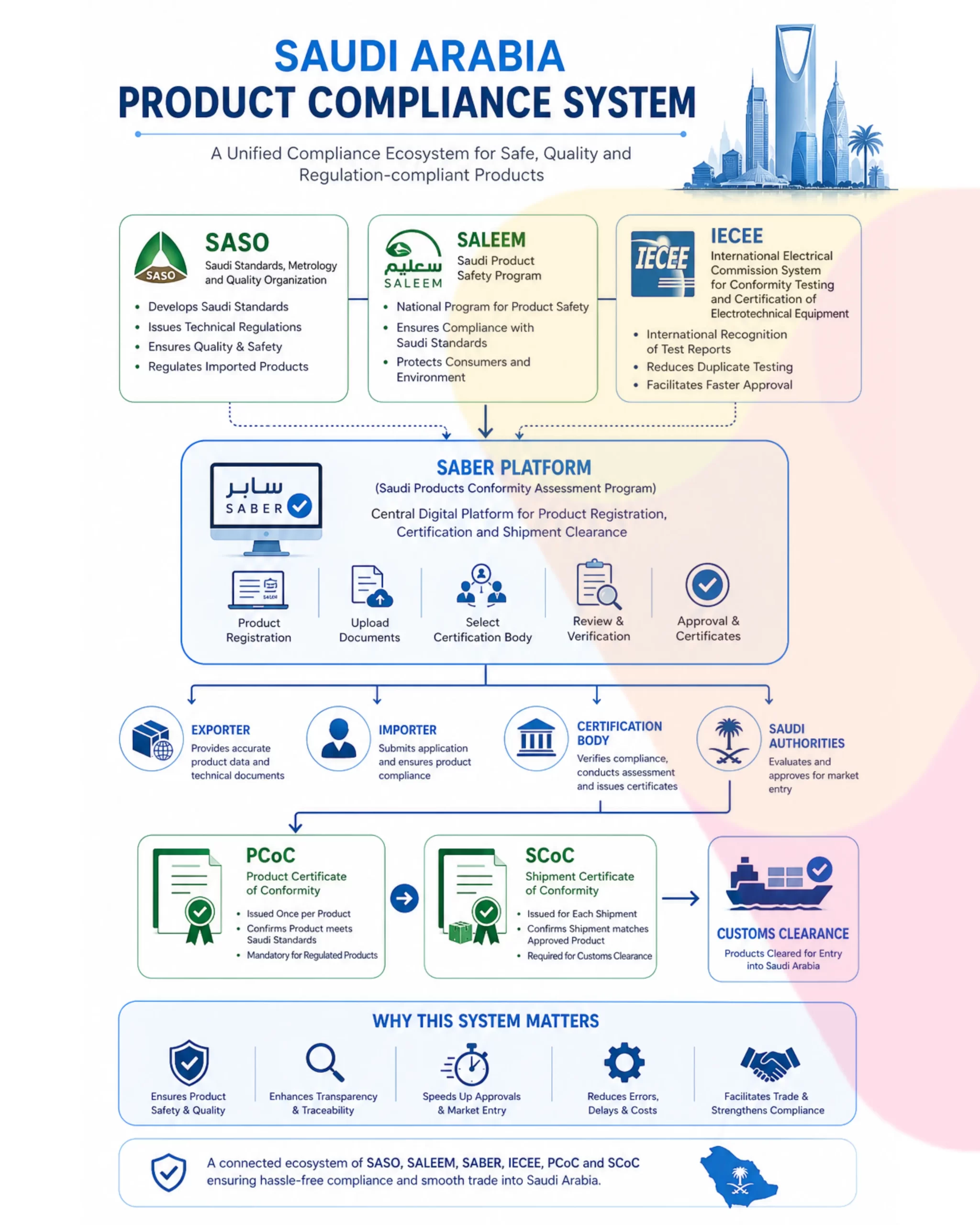
The main authority responsible for setting these standards is Saudi Standards, Metrology and Quality Organization
SASO develops technical regulations that define:
- Product safety requirements
- Performance standards
- Quality benchmarks
- Environmental compliance criteria
To make the compliance process more efficient and transparent, Saudi Arabia introduced the
Saudi Product Safety Program (SALEEM)
This program ensures that all regulated products go through a unified system before entering the market. The backbone of this system is the
SABER platform
The SABER platform is an online portal where:
- Products are registered
- Certifications are issued
- Shipments are approved
This means every exporter must work within this ecosystem. Without proper registration and certification through SABER, products cannot legally enter Saudi Arabia.
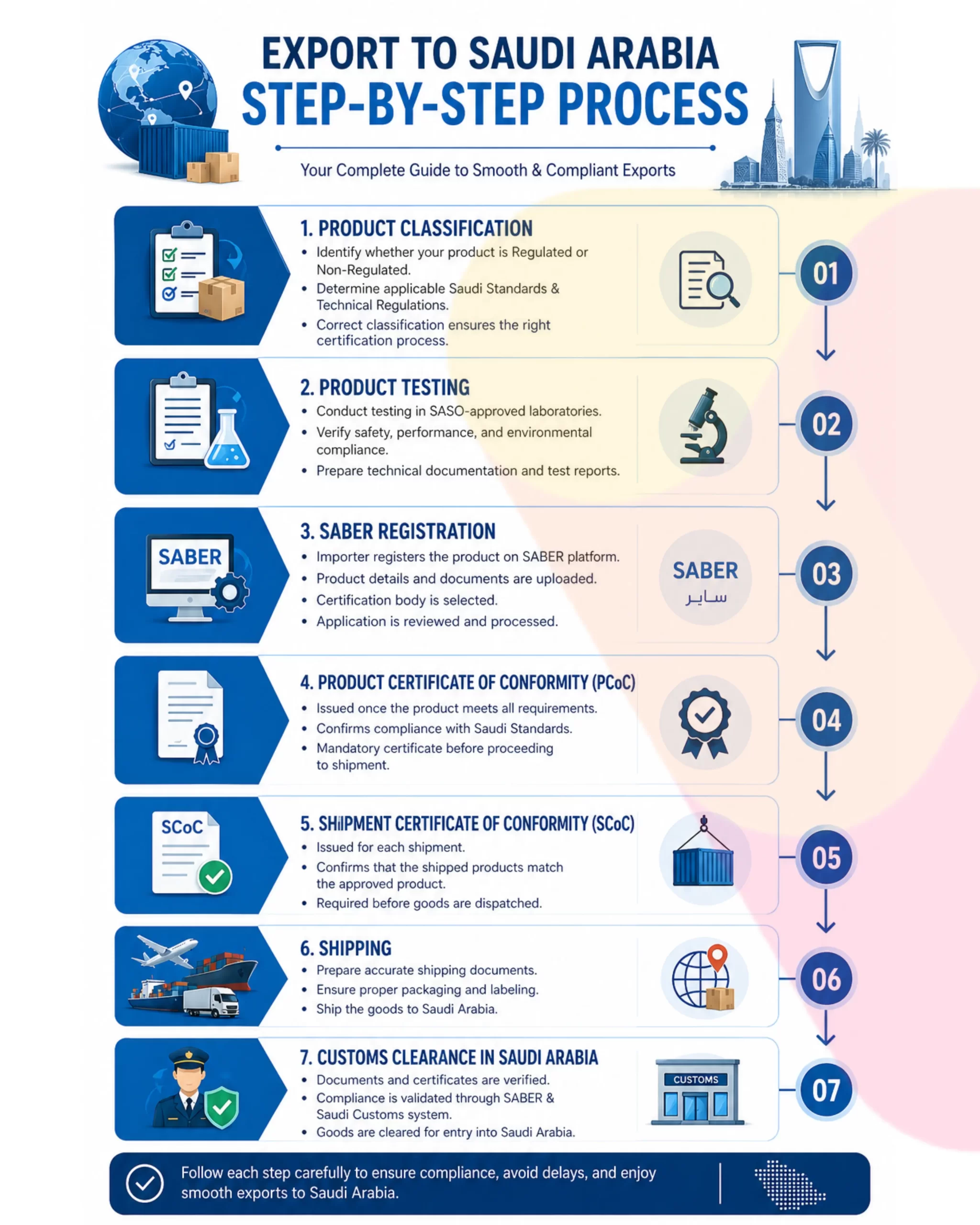
Product Classification: The Most Critical First Step
One of the most important—and often underestimated—steps in exporting to Saudi Arabia is correctly classifying your product.
Products are divided into two main categories:
Regulated Products
These products must comply with strict technical regulations and require certification before export. Examples include:
- Electrical and electronic equipment
- Building and construction materials
- Automotive parts
- Household appliances
- Toys and consumer goods
These products are subject to:
- Mandatory testing
- Certification requirements
- SABER registration
Non-Regulated Products
These products:
- Do not require full certification
- Still require documentation and declaration
Even though they are considered lower risk, they must still comply with general import rules.
Why Classification Matters
Correct classification determines:
- Whether certification is required
- Which standards apply
- What type of testing is needed
If a product is misclassified:
- The wrong certification process may be followed
- Documentation may not match requirements
- The shipment can be delayed or rejected
This step sets the foundation for the entire export process.
Product Testing and Compliance with Saudi Standards
Once the product category is identified, the next critical step is ensuring it complies with Saudi regulations. This is achieved through product testing and technical evaluation, which validates whether the product meets the required national standards.
Testing is conducted to confirm that the product aligns with:
- Safety standards
- Performance requirements
- Environmental regulations
- What Testing Involves
Depending on the product type, testing may include:
- Electrical safety checks (for electronic products)
- Mechanical durability and stress testing
- Chemical composition analysis
- Environmental impact evaluation
- Technical Documentation Required
Exporters must prepare and submit:
- Product specifications
- Design and technical details
- User manuals
- Safety and compliance reports
All testing must be conducted in:
- Approved laboratories
- Accredited testing facilities
If testing is not performed correctly or is conducted through unrecognized labs:
❌ Certification will not be approved
This step ensures that your product is technically validated and legally ready for entry into the Saudi market.
SABER Registration: The Mandatory Digital Process
After confirming product compliance, the next step is registering the product on the
SABER platform
This is a mandatory requirement for all regulated products entering Saudi Arabia.
How the SABER System Works
- The Saudi importer logs into the platform
- Product details are entered
- Required documents are uploaded
- A certification body is selected
- The application is reviewed and processed
The SABER platform connects:
- Exporters (providing product data)
- Importers (submitting applications)
- Certification bodies (verifying compliance)
- Authorities (approving entry)
Why SABER is Important
- Centralizes the entire compliance process
- Ensures transparency and traceability
- Minimizes errors and delays
Without SABER registration:
❌ Certification cannot be issued
❌ Shipment cannot be cleared
Get Expert SASO Certification Support
Avoid delays, rejections, and compliance errors by working with professionals. Our SASO certificate services help you handle SABER registration, documentation, and approvals seamlessly.
Contact us today for fast and reliable SASO certificate services and ensure smooth export to Saudi Arabia.
What Documents are Required to Export Goods to Saudi Arabia? Are They Mandatory?
Invoice
This invoice must include HS codes, country of origin, transport details, separate costs for CIF sales, package information, accurate goods description, and the exporter’s legitimate signature. Furthermore, It should be certified by the Chamber of Commerce.
Packing List
Detailing package contents, dimensions, and quantities for Saudi exports.
Product Certificate of Conformity (PCoC)
A Product Certificate of Conformity (PCoC) is a document that certifies that a specific product meets the established standards, regulations, and technical regulations of Saudi Arabia.
Shipment Certificate of Conformity (SCoC)
The Shipment Certificate of Conformity is a document that is used for a shipment to enter Saudi. Without the PCOC, you can’t get SCOC.
Bill of Lading, or Airway Bill
The Bill of Lading (for sea shipments) or Airway Bill (for air shipments) is a transport document that acknowledges the receipt of goods by the carrier for shipment.
Marking of Goods
Products must bear a permanent country of origin indication that cannot be removed, done through methods like engraving, sewing, printing, or pressing.
Note: Requirements can change, so verify with official sources before exporting to Saudi Arabia
These documents are mandatory for Saudi Arabia exports.
These export documents, like the Commercial Invoice, SCoC, and PCoC, have been mandatory for years to ensure compliance with Saudi Arabia’s technical regulations. Sending goods without them can lead to rejection. Additionally, exporters often require a conformity body, such as Verger Group, to issue SASO certificates, i.e. PCoC, SCoC, demonstrating compliance with standards for successful Saudi exports.
VEREGR Group is a SASO notified ISO-17020 inspection body and ISO-17065 conformity assessment body. If your product adheres to all the technical regulations for it provided by SASO, VERGER Group can issue your SASO/SABER Certificate very quickly. Reach out to us for more details on it.
Frequently Asked Questions by Importers and Exporters to Saudi Arabia
Is the SABER Certificate Issued for Exporters?
The SABER Certificate is primarily issued for products intended for sale in the Saudi Arabian market. It is issued for Exporters. It ensures that both local manufacturers and importers comply with safety standards. Moreover, this certificate is essential to demonstrate product adherence to Saudi regulations before distribution or importation.
Is SABER like a Normal Import-Export Certificate?
Absolutely correct. The SABER Certificate serves as an import approval, issued by conformity bodies like VERGER following product testing and factory audits conducted in accordance with SASO standards, ensuring compliance with Saudi regulations for imported goods.
How Long Does it Take to Issue The SABER Certificate?
The issuance time for the SABER Certificate depends on compliance. If documents align with SASO standards, the certificate is issued promptly. If not, product testing and factory audits (if needed) are conducted before certification.
Can An Agent Issue the Certificate?
The SABER/SASO Certificate can only be issued by Conformity bodies accredited by NABCB and approved by the government of Saudi Arabia.
What are the Fees and Procedures for Obtaining The SABER/SASO Certificate?
The issuance of SABER/SASO certificates can only be done by conformity bodies accredited by NABCB, VERGER Group can help you obtain your SASO/SABER certificate. For more details, reach out to VERGER Group at inquiry@verger-group.com and we’ll be happy to assist you.
What if My Goods are Stopped at Saudi Customs After Issuing This Certificate?
If the HS codes recommended by Verger match the exported product, customs issues are unlikely. However, if exporters/importers propose HS codes for the certificate, Verger disclaims responsibility for any customs delays. Moreover, accurate HS code alignment minimizes customs disruptions during the import process.
Are There Any Other Certificates/Documents Required Other Than SASO Certificate for Sending Goods to Saudi Arabia?
Yes, for Saudi exports, the primary requirement is the SASO Certificate issued by conformity bodies registered on the SABER portal. This certificate ensures compliance with Saudi standards. However, depending on the nature of the goods, additional documentation might be needed, such as the Commercial Invoice, Certificate of Origin, Packing List, and any industry-specific certifications.
How Long is PCOC/SCOC Certification Valid?
The validity of PCoC (Product Certificate of Conformity) is one year from the date of issuance. Whereas, SCoC (Shipment Certificate of Conformity) certification is valid for the duration of the shipment.
Which Conformity Body Can Issue the SABER Certificate?
The SABER Certificate can be issued by conformity bodies registered on the SABER platform. If you require assistance, you can contact VERGER Group, a reputable organization known for efficient and fast SABER certification processes, ensuring compliance for a smooth export experience.
Why VERGER?
In conclusion, exporting to Saudi Arabia reflects the strength and sophistication of a market that plays a vital role in global trade. The balance between imports and exports highlights a well-structured ecosystem driven by quality, compliance, and efficiency. As discussed throughout this guide, successful market entry depends on understanding regulations, meeting certification requirements, and aligning with Saudi standards at every stage of the export process.
With seamless integration into the Saudi Customs and compliance systems, VERGER helps businesses achieve faster approvals, smoother clearances, and complete regulatory confidence. By simplifying complex procedures and ensuring end-to-end compliance, VERGER empowers exporters to operate efficiently and expand confidently in the Saudi market.
To deepen your understanding, explore our related insights such as “Top 10 Products Saudi Arabia Imports” and “Quality Assurance vs Quality Control”, where we break down market opportunities and compliance fundamentals to support your export journey.