
Your products are manufactured. Your cartons are packed. Your customer is waiting. The shipping documents are ready.
Then the shipment gets delayed.
For exporters, being production-ready does not always mean being market-entry ready. When exporting regulated products to Saudi Arabia, requirements may include product registration, conformity assessment, SASO certification where applicable, shipment certification and technical documentation.
The Saber platform supports product and shipment certification as part of Saudi Arabia’s conformity process.
A shipment can therefore be physically ready while its compliance requirements are still incomplete. This can lead to Saudi shipment delays, unexpected costs and clearance issues.
Planning compliance requirements early can help exporters avoid Saudi shipment delays and keep shipments moving smoothly.
Here are seven common reasons this happens.
1. The Required Product Compliance Was Started Too Late
One of the biggest mistakes exporters make is treating compliance as a final shipping task.
The usual thinking is:
Manufacture → Pack → Book shipment → Check compliance
For regulated products, that sequence can create problems.
A better approach is:
Identify requirements → Determine applicable standards → Prepare technical documents → Testing/assessment → Certification/registration → Shipment preparation
Saudi technical regulations specify technical requirements and conformity assessment procedures for products within their scope.
If the exporter waits until the container is ready before checking which requirements apply, there may not be enough time to complete the necessary assessment.
What can happen?
A shipment may be ready while:
- Required testing is incomplete
- Technical documents are missing
- Product information needs clarification
- A conformity assessment application is still under review
- Product registration has not been completed
- A required shipment certificate has not been issued
The result is a simple but expensive problem:
The factory is ready. The logistics team is ready. But the compliance process is not.
How to avoid it
Start the compliance review before production is completed—ideally when the product, model, destination market and applicable requirements are known.
2. The Product Is Not Properly Registered or Linked to the Required Certificate
Having a certificate somewhere in your company files does not automatically mean the shipment is ready.
For commercial products, the Saudi system includes product registration and conformity certification processes. Saber describes its role as facilitating product registration, product conformity certificates and shipment certificates before products enter the Saudi market.
For regulated products, the conformity certificate process can involve selecting the product and model numbers, choosing a conformity assessment body, submitting the application, obtaining approval and completing the required procedures.
This creates a common risk:
The exporter believes the product is certified, but the specific product, model, certificate or shipment information is not correctly aligned with the shipment.
For example, issues can arise when:
- Model numbers do not match
- Product descriptions differ between documents
- The certificate does not cover the shipped products
- Product information has changed
- Required registration has not been completed
- Certificate validity has expired
- The importer has not completed the required platform process
Why this matters?
The compliance process is not simply about possessing a PDF certificate.
The relevant product information, certificates and shipment details need to be correctly connected to the required regulatory process.
3. The Shipment Certificate Has Not Been Completed
This is one of the most important points exporters need to understand.
A product conformity certificate and a shipment certificate are not necessarily the same thing.
For commercial imported products, Saber provides a service for issuing a shipment certificate. The listed requirements include product registration and either registration of a product conformity certificate or an applicable self-declaration.
Saber’s current information states that the shipment certificate service involves submitting the request, having the application reviewed and then issuing the shipment certificate.
For regulated products, approval by the relevant conformity assessment body can also be required before the shipment certificate is issued.
So an exporter may have:
Product manufactured ✔
Test report available ✔
SASO/conformity certificate available ✔
…but still need to complete the shipment-level compliance process.
The practical lesson
Don’t ask only:
“Is the product certified?”
Also ask:
“Is this specific shipment fully cleared from a product-compliance perspective?”
That distinction can prevent last-minute surprises.
4. The Technical File or Supporting Documents Are Incomplete
A product may physically meet the required specifications, but the supporting evidence still needs to be sufficient.
SASO’s conformity certification service references technical-file contents according to the applicable technical regulation and product type.
Depending on the product and applicable regulation, supporting documentation can include information such as:
- Product specifications
- Test reports
- Product photographs
- Technical documentation
- Manufacturer information
- Model numbers
- Product labels
- Existing certificates
- Instructions or manuals
- Applicable declarations
- Commercial and shipment information
The exact requirements vary according to the product and applicable technical regulation.
5. The Product Is Subject to a Technical Regulation You Didn’t Account For
Not every product follows exactly the same compliance pathway.
Saudi Arabia has technical regulations covering different product categories, including areas such as construction and building products, electrical products, mechanical products, textiles and chemicals.
The applicable requirements depend on factors such as:
- Product type
- Intended use
- Technical characteristics
- Product category
- Applicable Saudi technical regulation
- Relevant standards
This is why simply asking:
“Do I need a certificate?”
may not be the right starting question.
The better question is:
“Which Saudi requirements and conformity assessment procedure apply to this exact product?”
Why classification matters
If an exporter identifies the wrong product category or assumes the wrong regulatory pathway, they may begin the wrong testing or certification process.
That can lead to:
Wrong requirement → Wrong testing → Rework → New documents → Delayed certification → Delayed shipment
This is particularly painful when the mistake is discovered after manufacturing has already been completed.
Better approach
Determine the applicable technical regulation and conformity assessment requirements before committing to the final compliance pathway.
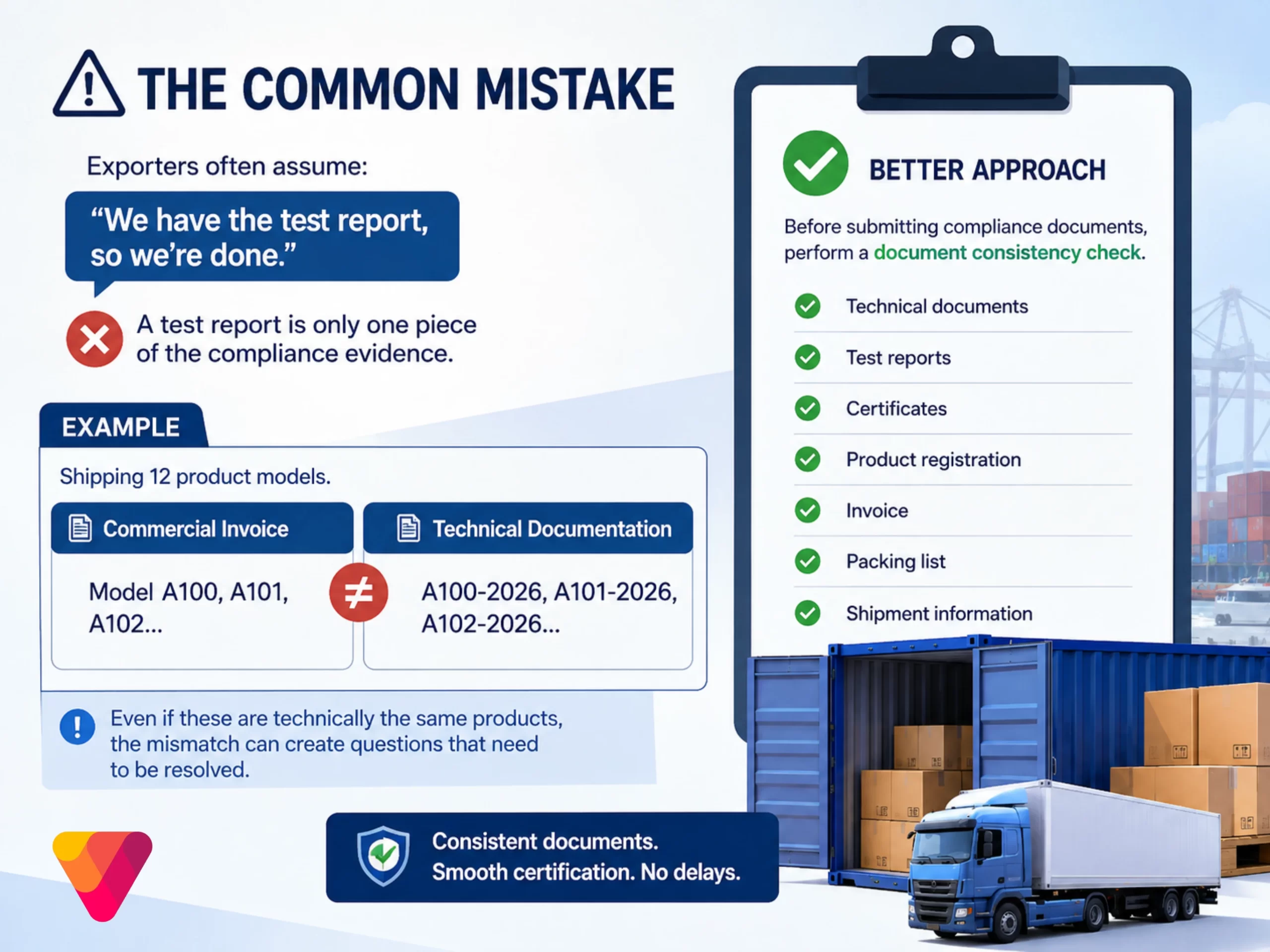
6. Product Information and Shipping Documents Don’t Match
Sometimes the compliance certificate is correct—but the shipment information creates the problem.
Think about how many documents can be involved in one export shipment:
- Commercial invoice
- Packing list
- Bill of lading
- Product certificate
- Shipment certificate
- Product registration information
- Technical documents
- Manufacturer details
- Importer information
If critical information doesn’t match across documents, clarification may be required.
Common examples
Invoice:
“LED Flood Light 100W”
Technical file:
“LED Floodlight Model X100”
Certificate:
“X100 LED Lighting Fixture”
Or:
Certificate: Model 500A
Shipment: Model 500B
Or:
Manufacturer: Company ABC Ltd.
Supporting document: Company ABC Manufacturing LLC
These differences may appear minor internally, but they can create unnecessary questions during compliance review.
The solution
Before shipment, perform a cross-document verification.
Check:
Manufacturer name
↓
Importer information
↓
Product description
↓
Model number
↓
Quantity
↓
Certificate details
↓
Shipment details
The goal is simple:
One shipment. One consistent set of information.
7. Labeling or Product-Marking Requirements Were Overlooked
A product can meet technical requirements and still face problems if its labeling or product information does not satisfy applicable requirements.
This is an area exporters should monitor carefully because labeling requirements can change as regulations are updated.
For example, the Saber platform currently carries an important notice stating that, starting 1 October 2026, the supplier’s name—importer or local manufacturer—and commercial registration number must be included on the product as part of labeling information requirements for ten technical regulations.
That is exactly why exporters should not rely on an old checklist indefinitely.
Before production, verify:
- Required product markings
- Label language requirements where applicable
- Manufacturer/importer information
- Model identification
- Warning information
- Technical information
- Regulatory marks where applicable
- Packaging requirements
Why check before manufacturing?
Because discovering a labeling problem after thousands of units have been produced is very different from discovering it before the production run begins.
A correction at the design stage may be simple.
A correction after production may involve:
Re-labeling → Repacking → Additional labor → Delayed dispatch → Additional cost
A Critical Point: “Ready to Ship” Is Not the Same as “Ready to Enter Saudi Arabia”
This is the biggest lesson for exporters.
A shipment can be:
Production-ready
The product has been manufactured.
Logistics-ready
The goods are packed and transportation is arranged.
Commercially ready
The buyer, invoice and purchase order are ready.
But still not be:
Compliance-ready
The applicable requirements, documentation, certification, registration and shipment-level requirements have been completed.
Think of the process like this:
🏭 PRODUCT READY
↓
📋 REQUIREMENTS VERIFIED
↓
🧪 TESTING COMPLETED
↓
🔍 ASSESSMENT / INSPECTION COMPLETED WHERE REQUIRED
↓
📜 SASO / CONFORMITY CERTIFICATION COMPLETED WHERE APPLICABLE
↓
💻 PRODUCT / CERTIFICATE REGISTRATION COMPLETED
↓
📦 SHIPMENT REQUIREMENTS COMPLETED
↓
🚢 SHIPMENT READY
↓
SAUDI MARKET
The exact pathway depends on the product and applicable Saudi requirements, but the principle remains the same: market-entry compliance needs to be planned as part of the export process, not treated as an administrative task after production.
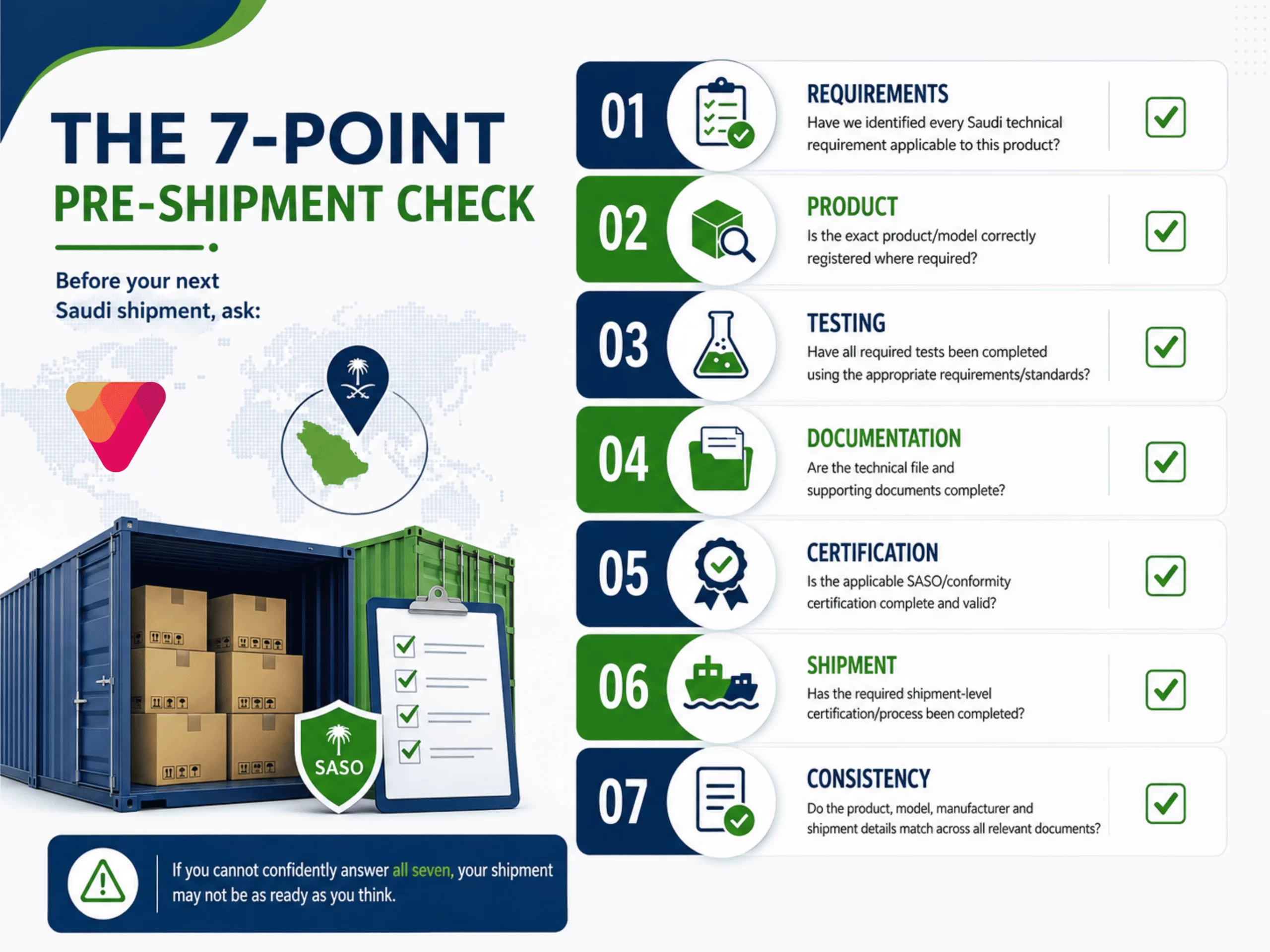
Before your next Saudi shipment, ask:
The 7-Point Pre-Shipment Check
What Exporters Should Do Differently?
The biggest change is simple:
Don’t start compliance when the container is ready.
Start when you know:
What you’re selling + where you’re selling it + who is importing it + which requirements apply.
This gives your compliance team time to identify gaps before they become shipment problems.
For manufacturers exporting regularly to Saudi Arabia, compliance should become part of the standard export workflow.
Not an emergency task.
Not something checked one day before dispatch.
And definitely not something discovered at the border.
Final Takeaway
A delayed Saudi shipment isn’t always caused by a logistics problem.
Sometimes the real problem happened weeks earlier:
- The applicable requirement wasn’t identified.
- The product wasn’t registered correctly.
- The certificate didn’t cover the shipment.
- The technical file wasn’t complete.
- The shipment certificate wasn’t ready.
- The documents didn’t match.
- The labeling requirements were overlooked.
The good news is that most of these risks can be identified before the container leaves the factory.
For exporters, that is the real value of proactive compliance:
Don’t wait for the shipment to reveal the problem. Find the problem before the shipment.
How VERGER Can Help
For manufacturers and exporters supplying the Saudi market, VERGER can support the compliance journey through services including SASO certification, product testing, inspection, conformity assessment and certification support.
The objective isn’t simply to obtain another document.
It is to help businesses identify and address compliance requirements before they become costly shipment problems.
If your next Saudi shipment is already being planned, reviewing the compliance requirements early can help reduce avoidable delays, rework and uncertainty.
Need help reviewing your Saudi product compliance requirements? Contact VERGER Group before your next shipment.
Regulatory requirements can vary by product category and may be updated. Exporters should verify the requirements applicable to their specific products before shipment.