
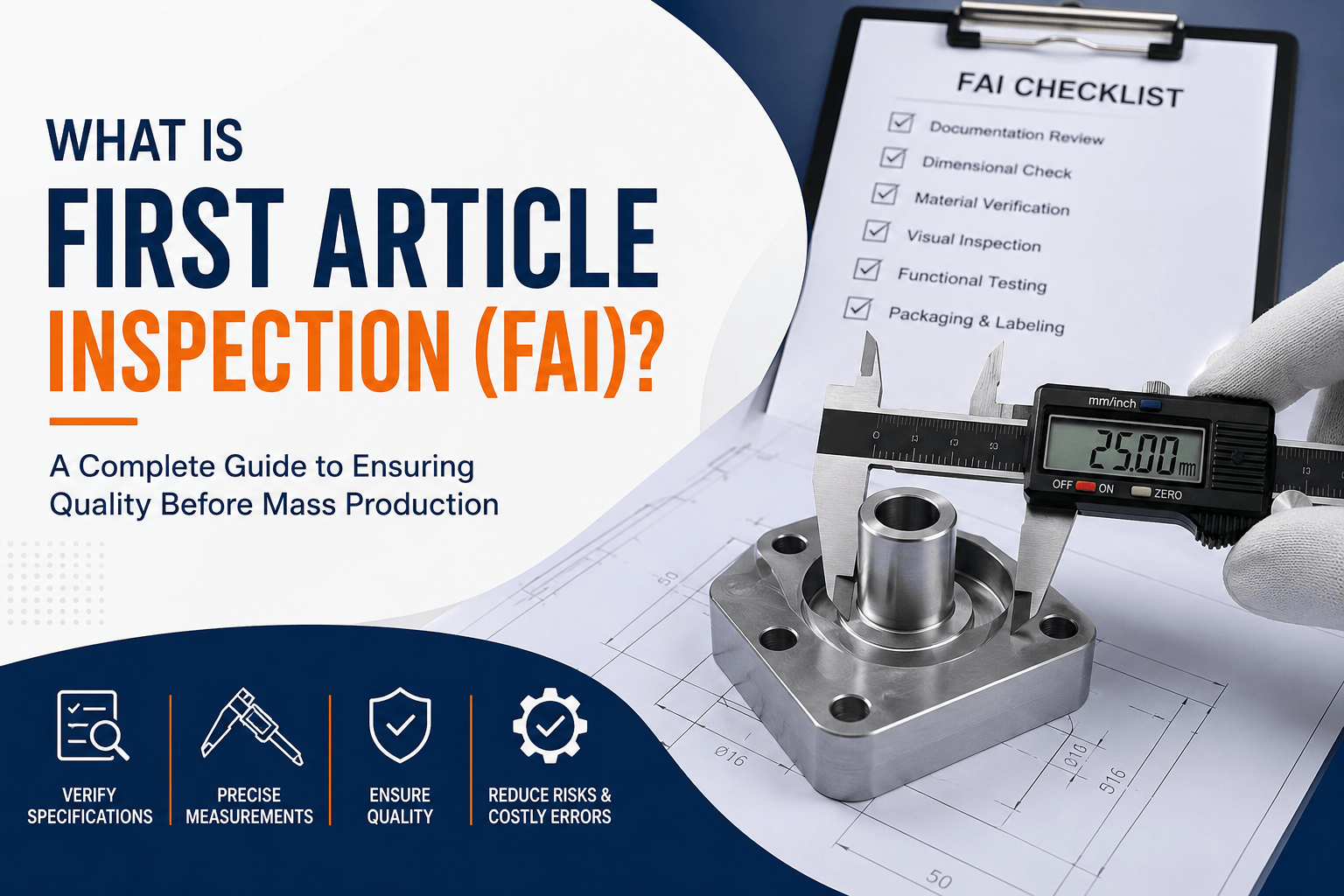
Manufacturing a high-quality product is about much more than having a good design. Every stage of the production process—from sourcing raw materials to assembling the final product—must be carefully controlled to ensure consistency and compliance with customer requirements. Even a small mistake during the initial stages of production can lead to thousands of defective products, costly recalls, shipment delays, and damage to a company’s reputation.
For manufacturers, importers, exporters, and global buyers, preventing these issues before they occur is far more effective than correcting them after production is complete. This is where First Article Inspection (FAI) becomes an essential part of quality assurance.
First Article Inspection is a comprehensive verification process carried out on the very first product manufactured from a production run. It ensures that the product has been manufactured exactly according to the approved engineering drawings, technical specifications, and customer requirements before full-scale production begins. By identifying potential issues at the earliest stage, FAI helps manufacturers minimize risks, reduce production costs, and deliver products that consistently meet quality standards.
Understanding First Article Inspection (FAI)
First Article Inspection (FAI) is a detailed quality inspection performed on the first completed unit produced during a manufacturing process. The purpose of this inspection is to verify that the production process, machinery, materials, and workmanship are all capable of producing products that conform to the required specifications.
Rather than simply checking whether a product looks correct, an FAI involves an in-depth examination of every critical aspect of the product. Inspectors compare the manufactured item against engineering drawings, technical documents, customer specifications, and applicable industry standards to ensure complete compliance.
Think of First Article Inspection as a final validation before committing to mass production. If any problems are discovered during this stage, manufacturers can correct them immediately before producing hundreds or thousands of additional units. This proactive approach saves significant time, money, and resources while ensuring customers receive products that meet their expectations.
Why First Article Inspection Is Important?
Quality problems often begin with the first production sample. A minor programming error in a CNC machine, an incorrect raw material, or a misunderstanding of the engineering drawing can quickly result in large quantities of defective products if production continues unchecked.
Without a First Article Inspection, these issues may only become apparent after the products have been shipped or delivered to customers. At that point, businesses may face expensive product recalls, rejected shipments, warranty claims, damaged customer relationships, and production downtime.
By conducting an FAI before mass production starts, manufacturers gain confidence that every aspect of the manufacturing process is working correctly. It acts as an early warning system that identifies defects before they become major business problems.
In today’s highly competitive global market, where products are frequently sourced from suppliers located in different countries, FAI provides buyers with assurance that their supplier fully understands the product requirements and is capable of producing consistent quality.
When Should a First Article Inspection Be Conducted?
Although First Article Inspection is commonly associated with new product launches, it is required in many other situations as well.
An FAI should always be performed when a completely new product enters production. Since no previous manufacturing data exists, the first manufactured unit must be carefully verified before production continues.
It is equally important whenever production is transferred to a new supplier or factory. Even if the product design remains unchanged, different machinery, operators, and manufacturing processes can introduce unexpected variations.
Engineering changes also require a new First Article Inspection. A modified dimension, revised material specification, or updated assembly process may significantly affect the final product. Conducting an FAI ensures these changes have been implemented correctly.
Similarly, manufacturers often perform a new FAI after replacing production tooling, introducing new molds, changing raw materials, or restarting production after an extended shutdown. These situations have the potential to alter product quality, making inspection essential before manufacturing resumes.
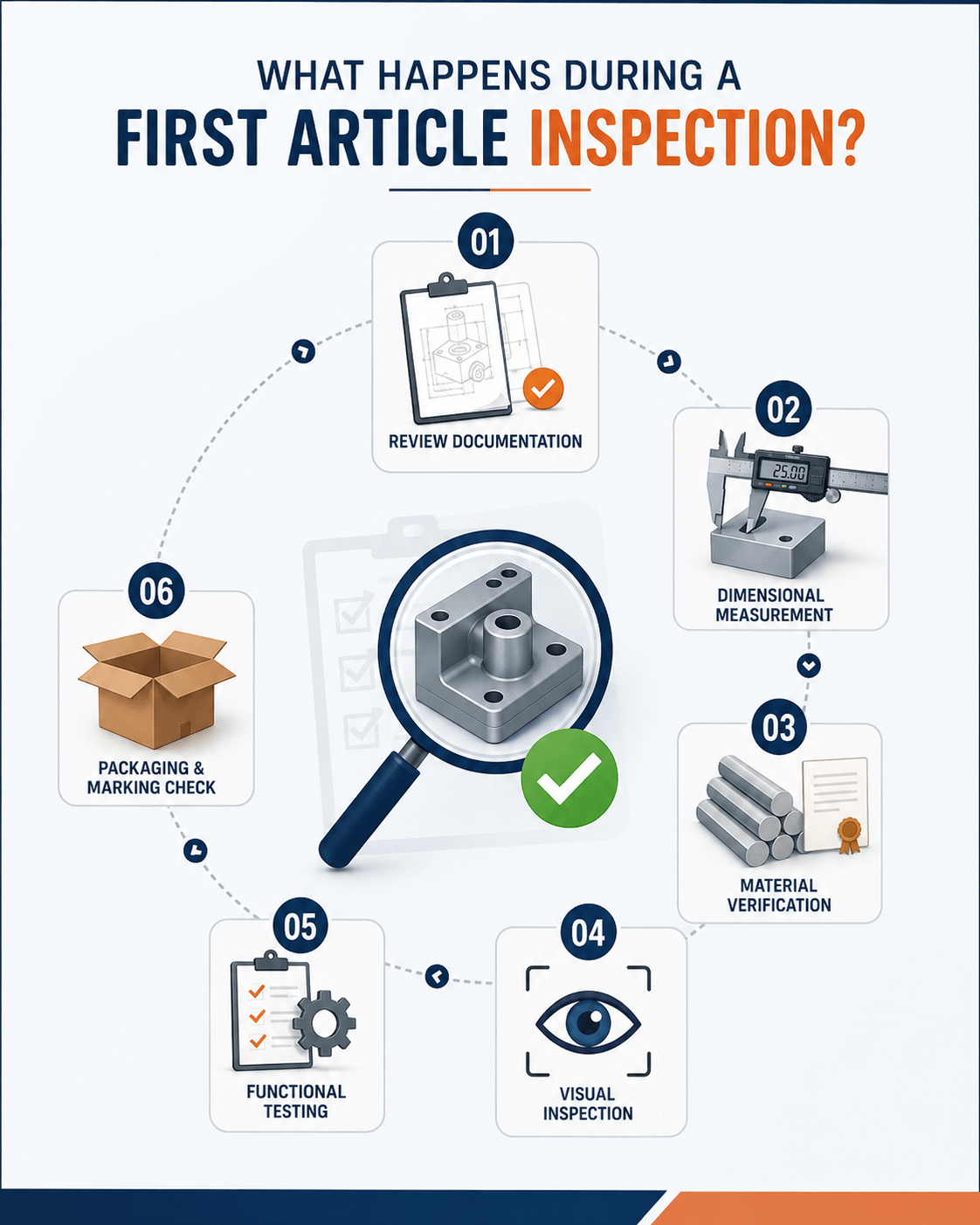
What Happens During a First Article Inspection?
A professional First Article Inspection involves much more than simply measuring a few dimensions. It is a systematic evaluation of the product and the manufacturing process.
The inspection usually begins with a review of all technical documentation. Inspectors carefully examine engineering drawings, product specifications, purchase orders, bills of materials, and customer requirements to understand exactly how the product should be manufactured.
Once the documentation has been verified, inspectors examine the first manufactured product in detail. Every critical dimension is measured using calibrated inspection equipment such as vernier calipers, micrometers, height gauges, coordinate measuring machines (CMMs), or other precision instruments. These measurements are then compared against the approved engineering drawings to ensure they fall within the specified tolerances.
Material verification is another important part of the inspection process. The inspector confirms that the correct raw materials, components, coatings, finishes, and treatments have been used throughout the product. Material certificates and supplier documentation may also be reviewed to verify compliance.
The product is then visually inspected for any cosmetic or workmanship defects. Surface scratches, dents, poor welding, paint imperfections, assembly defects, and other visible issues are carefully documented.
If the product includes functional features, inspectors conduct operational testing to verify that it performs exactly as intended. Depending on the product type, this may include electrical testing, pressure testing, load testing, mechanical operation, or other performance evaluations.
Finally, packaging, labels, barcodes, manuals, and shipping marks are reviewed to ensure the finished product is ready for distribution and meets customer requirements.
The First Article Inspection Report
Once the inspection has been completed, all findings are compiled into a comprehensive First Article Inspection Report.
This report serves as official evidence that the inspected product has been evaluated against all specified requirements. It includes product identification, engineering references, inspection measurements, material verification, visual inspection results, functional testing records, photographs, identified non-conformities, and corrective actions taken where necessary.
The report provides complete traceability and becomes an important quality document for both manufacturers and customers. In many industries, it is a mandatory requirement before production approval can be granted.
Industries That Rely on First Article Inspection
First Article Inspection is widely used across industries where precision, safety, and consistency are critical.
The aerospace industry depends heavily on FAI because even the smallest manufacturing deviation can affect aircraft safety. Automotive manufacturers also use First Article Inspection extensively to ensure every component meets strict engineering tolerances before entering assembly lines.
Medical device manufacturers rely on FAI to verify that products comply with regulatory requirements and perform safely in clinical environments. Electronics companies use the process to validate circuit boards, connectors, and electrical assemblies before large-scale production begins.
Industrial machinery manufacturers, consumer goods producers, oil and gas equipment suppliers, construction material manufacturers, renewable energy companies, and defense contractors also use First Article Inspection as an essential part of their quality management systems.
First Article Inspection vs. Pre-Shipment Inspection
Many people confuse First Article Inspection with Pre-Shipment Inspection, but they serve very different purposes.
First Article Inspection is conducted at the beginning of production to verify that the manufacturing process is capable of producing products according to specifications. Its primary objective is to prevent defects before mass production begins.
Pre-Shipment Inspection, on the other hand, is performed after production has been completed and before the goods are shipped to the buyer. Its purpose is to confirm that the finished products meet quality requirements before they leave the factory.
While First Article Inspection focuses on process validation and production readiness, Pre-Shipment Inspection focuses on verifying the quality of the completed production batch. Many international buyers choose to use both inspections to ensure complete quality assurance throughout the manufacturing process.
Benefits of First Article Inspection
Investing in First Article Inspection offers long-term benefits that extend far beyond identifying manufacturing defects.
By detecting problems early, businesses can avoid expensive rework, production delays, material waste, and rejected shipments. Manufacturers gain greater confidence that their production processes are stable, while buyers receive assurance that their products will be manufactured according to agreed specifications.
FAI also strengthens communication between customers and suppliers by ensuring everyone shares the same understanding of product requirements before production begins. This leads to fewer misunderstandings, improved product consistency, and stronger long-term business relationships.
For companies sourcing products internationally, First Article Inspection provides valuable visibility into supplier performance and significantly reduces the risks associated with overseas manufacturing.
Why Third-Party First Article Inspection Matters?
While some manufacturers perform internal inspections, many buyers prefer using an independent third-party inspection company. An unbiased inspection provides greater transparency and builds trust between buyers and suppliers.
Third-party inspectors bring specialized expertise, calibrated inspection equipment, and extensive experience across different industries. Because they are independent, their assessment is objective and focused solely on verifying compliance with customer requirements.
Independent inspection reports are often accepted by international buyers as reliable evidence that production meets contractual and regulatory standards.
Conclusion
First Article Inspection is much more than a routine quality check—it is one of the most effective risk management tools in modern manufacturing. By verifying the very first production sample before mass manufacturing begins, businesses can identify problems early, reduce production costs, improve product quality, and prevent expensive failures later in the supply chain.
As global supply chains continue to expand, ensuring manufacturing accuracy from the very first product has become essential for maintaining customer satisfaction and protecting brand reputation. Whether you are launching a new product, changing suppliers, or introducing design modifications, conducting a professional First Article Inspection provides the confidence that your production process is ready for success.