
Effective quality control in India rests on five checkpoints: audit the factory before you order, inspect before production starts, check during production, inspect before shipment and verify loading. Add accredited lab testing for your destination market, and check whether India’s export inspection or BIS rules apply to your product. This guide explains each step, the risks specific to Indian sourcing, and what to ask of your suppliers and inspectors.
What Quality Control in India Covers?
Buyers use several terms loosely, so it helps to separate them. Quality control in India normally combines four activities:
- Factory audit: an assessment of the supplier’s capacity, systems and working conditions before you place an order
- Inspection: checks on materials, products and packing at defined stages of production
- Laboratory testing: measurement of materials and finished goods against technical and legal requirements
- Corrective action: agreed fixes, retests and follow-up when a check fails
Quality assurance is different. It is the factory’s own system for preventing defects, such as procedures, training and process control. Quality control checks the output. A factory with a strong quality assurance system makes your checks easier, but it does not replace them.
Why Quality Control in India Needs Its Own Playbook?
India is one of the most varied sourcing countries in the world. One buyer may order knitwear from a textile cluster, brassware from a handicraft town and machined parts from an industrial belt, and each supply chain has its own habits, suppliers and weak points. A checklist copied from another country will miss them. Quality control in India therefore starts with knowing which cluster, which supplier tier and which season your order runs through.
Three features shape most orders:
- Regional clusters. Many products come from hubs where small and medium factories share raw materials, labour and subcontractors.
- Tiered production. An order accepted by a larger factory may be partly made in smaller units that you have never seen.
- Weather and calendar. Monsoon humidity, festivals and harvest cycles affect materials, staffing and lead times more than in many other sourcing markets.
Quality Control in India by Product Group
The risks below are typical patterns, not guarantees. Use them to decide what your inspector should check first, then adapt them to your own specification.
Quality Control in India for Garments and Knitwear
Knitwear and garments come mainly from clusters such as Tirupur, Ludhiana and the Delhi region. The usual problems are shade variation between lots, shrinkage after washing, measurement drift, stitching faults and loose needles or metal fragments. Prioritise measurements against the spec sheet, a shade band approved before bulk cutting, a wash test, a visual check against the agreed quality limit and metal detection. Our fabric inspection service covers the fabric stage.
Home Textiles
Panipat and Karur are well-known home textile hubs. Check fabric weight (GSM) and thread count against the specification, colourfastness, and whether goods are packed dry, because damp packing leads to mould in transit.
Handicrafts, Brassware, Decor and Furniture
Moradabad, Jaipur and Saharanpur are known for brassware, decor and wooden furniture. Typical issues are uneven finish between pieces, plating or lacquer that peels, wood that warps as it dries and damage in transit. Approve a golden sample for finish, measure wood moisture before packing and run a carton drop test.
Leather and Footwear
Kanpur, Agra and the Chennai region are major leather and footwear centres. Watch for colour and finish variation, weak sole bonding, stitching faults and odour. Ask for bond strength tests and restricted-substance test reports that match your destination market.
Quality Control in India for Engineering and Auto Components
Engineering clusters around Pune, Chennai and Rajkot supply machined, cast and fabricated parts. The main risks are out-of-tolerance dimensions, the wrong material grade and surface treatment faults. Require a dimensional report, material test certificates and first article approval before bulk production.
Food and Agricultural Products
Food and agricultural exports face contamination, moisture, labelling and shelf-life risks. Combine a sampling plan with lab tests for contaminants and a label check. Some products, such as certain fish, dairy, egg, honey and meat products, are also subject to mandatory export inspection by India’s Export Inspection Council, covered below.
India-Specific Risks That Affect Quality Control in India
Five factors shape quality control in India more than most buyers expect. Plan around them from the start.
Monsoon Humidity
From roughly June to September, damp air affects textiles, leather, paper, wood and cartons. Add moisture checks for materials and finished goods, and look at how and where stock is stored before packing.
Festival and Harvest Calendars
Staff absences around major festivals and harvest periods can slow production or lead to rushed work. Build buffers into the schedule and avoid planning final inspections in the busiest weeks.
Hidden Subcontracting
Ask the supplier to name every unit involved in your order, and state in the purchase order that production cannot move without your written approval. An unannounced visit during production is the fastest way to confirm what is really happening.
Raw Material Variation
Yarn, fabric, metal and chemical inputs can vary between lots. Check incoming material certificates and keep a retained sample from the approved lot to compare against later batches.
Records and Traceability
Ask for batch and lot records. They make a defect easy to trace and a corrective action easy to verify.
The Five-Checkpoint Plan for Quality Control in India
Use the five checkpoints below to build a quality control in India plan that matches the risk of each order.
Checkpoint 1: Audit the Factory Before You Order
An audit confirms capacity, machinery, quality systems, subcontracting practices and working conditions before you commit. It is the best moment to find a gap between what a supplier says and what the factory can do. See our factory audit services.
Checkpoint 2: Inspect Before Production Starts
Before bulk production, confirm that materials, samples and approvals match the order. Read our guides to pre-production inspection and first article inspection.
Checkpoint 3: Check During Production
Check when a good share of the order is made, typically between 20 and 60 per cent, while there is still time to correct problems. This is where hidden subcontracting, process drift and material substitutions show up. See during production inspection.
Checkpoint 4: Inspect Before Shipment
A pre-shipment inspection checks a random sample of finished goods against the agreed quality limit, plus packing, marking and quantities. Book it when at least 80 per cent of the order is complete and packed. See pre-shipment inspection.
Checkpoint 5: Verify Loading
Loading supervision confirms that the right goods, in the right quantity and condition, are loaded and sealed in the container. See loading and unloading supervision.
How Many Checkpoints Does Your Order Need?
| Situation | Suggested checkpoints |
|---|---|
| First order from a new supplier | All five |
| Repeat order from a proven supplier | Pre-shipment inspection, plus during production for complex products |
| High-risk products (children’s, food, electrical) | All five, plus lab tests |
| Urgent shipment | Pre-shipment inspection and loading supervision |
How Sampling and Acceptance Work?
Inspectors use sampling tables, commonly those in ISO 2859-1, instead of checking every piece. The acceptable quality limit (AQL) sets how many defects a lot can contain and still pass. Defects are classed as critical (unsafe or illegal), major (likely to affect use or sale) or minor (small cosmetic issues).
For example, a lot of 2,000 pieces at general inspection level II calls for a sample of 125 pieces. At an AQL of 2.5 for major defects, the lot passes with up to 7 major defects and fails at 8. At an AQL of 4.0 for minor defects, it passes with up to 10 and fails at 11. Critical defects are normally not accepted at all.
Agree the AQL, inspection level and defect definitions with the supplier in the purchase order, before production. They cannot be negotiated fairly after the inspection.
Examples of the Checkpoints in Practice
The three examples below are hypothetical. They are not client cases, and the numbers are chosen only to show how each checkpoint works.
Example 1: Shade Variation Caught During Production
Illustrative example. A buyer orders 5,000 knit tops. At a during production inspection, when about 40 per cent of the order is sewn, the inspector finds that two dye lots differ from the approved shade band. Chest width is also 1 cm under the specification on 12 of 80 pieces measured. The buyer holds the affected lots, the supplier re-sorts the lots and adjusts the cutting pattern, and the order ships on time. Finding the problem at this stage meant a fix before packing, not a failed pre-shipment inspection.
Example 2: Moisture Found at Pre-Shipment in the Monsoon
Illustrative example. A buyer orders wooden decor pieces. During the monsoon season, the pre-shipment inspector measures wood moisture above the agreed limit of 12 per cent and notes damp cartons in storage. Under the purchase order, shipment is held. The supplier dries the pieces, repacks them in dry cartons and pays for the re-inspection. The buyer avoids warped goods and mould on arrival.
Example 3: Hidden Subcontracting Found at First Article Stage
Illustrative example. A buyer orders machined brackets. At the during production visit, the inspector finds that one machining step is done at a workshop that was not named in the order. The dimensional report does not match the approved first article. The lot is held until the second workshop passes its own first article approval. The purchase order’s rule against unapproved subcontracting gives the buyer the right to hold it.
What to Take From These Examples?
Each problem was found by a planned check, and each was settled by a term already written into the purchase order. Checks find problems, and contract terms decide who fixes them.
Laboratory Testing and Quality Control in India
Inspection shows how a product looks and performs. Lab tests show what it is made of and whether it meets legal limits. Together they complete quality control in India for products that must meet chemical, safety or performance requirements.
Choose an Accredited Laboratory
Ask for reports from a laboratory accredited to ISO/IEC 17025, for example by NABL, India’s laboratory accreditation body, or by another body recognised under the ILAC arrangement. Check that the accreditation scope covers the test methods you need.
Test Production Material, Not Hand-Made Samples
Test to your destination market’s requirements, not only the factory’s own specification. Draw the samples from production material, so the report reflects what you will actually receive.
Indian Regulations That Can Affect Your Order
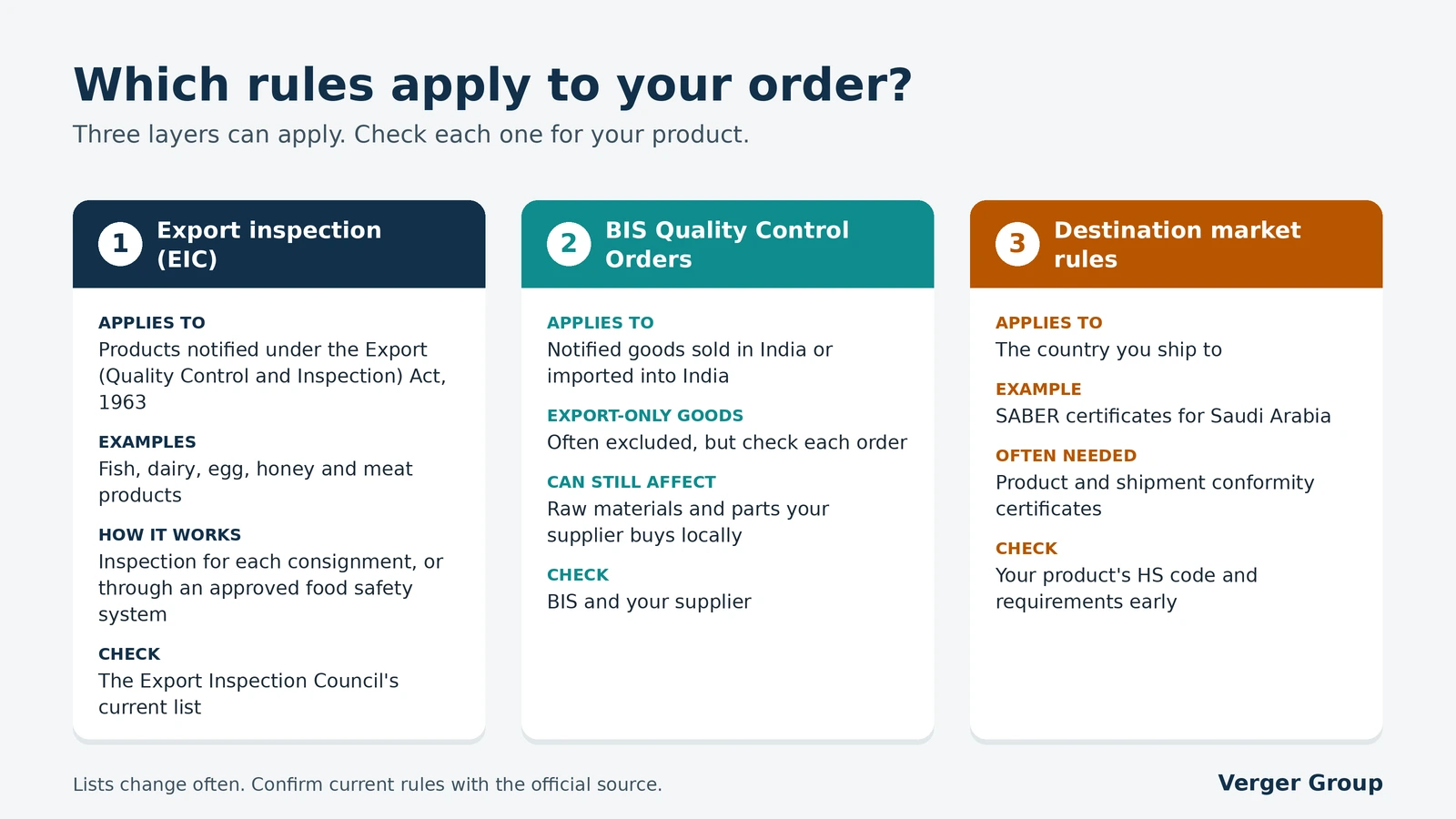
Do not confuse your own quality control in India plan with the country’s regulatory system. Two government regimes often come up.
Export Inspection by the Export Inspection Council
The Export Inspection Council (EIC) works under the Export (Quality Control and Inspection) Act, 1963. Products notified under the Act need inspection and certification before export, either consignment by consignment or through an approved food safety management system, and the Council’s Export Inspection Agencies carry out the work. Notified products include fish and fishery products, milk and milk products, honey, eggs, meat products and feed additives. The Council also runs a voluntary certification scheme for products that are not notified but for which an importing country asks for a certificate from India’s competent authority. Check the current list on the Council’s website.
BIS Certification and Quality Control Orders
The Bureau of Indian Standards (BIS) runs mandatory certification for products named in government Quality Control Orders. These orders mainly concern goods made for sale in India or imported into India, and some exclude goods made only for export. They can still affect the raw materials and components your supplier buys locally, so ask suppliers whether any of their inputs are covered. The lists change often, so confirm the current position with BIS or your supplier before you rely on it.
Exporting From India to Saudi Arabia and the Gulf
If your shipment is going to Saudi Arabia, connect your quality control in India plan with SABER certification. Many regulated products need product and shipment conformity certificates, and certificate problems are a common cause of port delays. Plan testing and the factory inspection together, so the same samples serve both. Read about our SASO and SABER certificate service and why Saudi shipments get delayed.
Contract Terms That Support Supplier Quality
Put the following in your purchase order or quality agreement, and have your legal adviser review the wording.
- Defect classes, AQL and inspection level
- Approved samples, with a rule that production follows them
- No subcontracting or change of materials without written approval
- Access for scheduled and unannounced inspections
- Hold points: the shipment waits for inspection release
- Rework and re-inspection at the supplier’s cost when a lot fails
- Batch records and material certificates supplied with each shipment
- Payment terms linked to the inspection result
Red Flags That Call for a Closer Look
- The supplier resists an unannounced visit
- The factory cannot name its subcontractors
- Approved samples and production goods look different
- Material certificates are missing or do not match the batch
- Production is far behind schedule, followed by a promise to catch up
- Damp storage areas or unsealed packing materials
- Inspection records that are unusually perfect
- Repeated last-minute changes to materials or processes
Timing and Cost
Timing depends on the product, the sample size and the travel distance to the factory. Cost depends on the type of inspection, the number of inspector days and any lab testing. Booking early, with the specification and approved samples ready, avoids delays and repeat visits.
How Verger Group Supports Quality Control in India?
Verger Group supports quality control in India with factory audits, pre-production, during production and pre-shipment inspections, fabric inspection and loading supervision. We are an ISO/IEC 17020 accredited inspection body and an ISO/IEC 17065 accredited certification body, SASO-notified, with headquarters in Dubai and branch offices in India, China, Turkey and Egypt. We can combine inspections with SABER certification for Saudi-bound goods. Contact us with your product, supplier location and shipment date, and we will recommend the checkpoints you need.
FAQ
What is quality control in India?
It is the set of audits, inspections and tests that confirm Indian suppliers deliver goods that meet your specification and the rules of your destination market.
How many inspections should I book?
At minimum, a pre-shipment inspection. Add a during production inspection for new suppliers, complex products or large orders.
Do I still need an inspection if the factory has ISO 9001?
Yes. ISO 9001 shows that the factory has a quality system. It does not prove that your batch meets your specification.
Do goods I export from India need BIS certification?
Often not, because many Quality Control Orders concern goods sold in India or imported into India, and some exclude export-only production. Check the order that covers your product, and ask your supplier about their inputs.
Which products need EIC inspection before export?
Products notified under the Export (Quality Control and Inspection) Act, 1963, including fish, dairy, egg, honey and meat products. The Export Inspection Council publishes the current list.
Can inspections be done in the monsoon season?
Yes, but add checks for moisture in materials, finished goods and packing, and check storage conditions.
Do goods from India going to Saudi Arabia need extra certificates?
Many regulated products need SABER product and shipment conformity certificates before shipment. Check your product’s HS code and requirements early.
Who pays for inspection?
Usually the buyer, but agree this in the contract. Re-inspection after a failed lot is commonly charged to the supplier.
Conclusion
Quality control in India works best when you plan it before production starts. Know your supplier, agree the AQL and contract terms in the purchase order, and match the inspections to the risk of each order. Allow for the monsoon and festival season, and test to your destination market’s requirements.
Regulations change, so check the latest Export Inspection Council, BIS and SABER requirements before every new order