
Toys compliance in Saudi Arabia involves more than importing products and completing customs procedures. Toys placed on the Saudi market must meet applicable safety requirements, undergo the required conformity assessment, carry the required warnings and conformity marking, and be supported by appropriate technical documentation.
The GCC Technical Regulation on Children Toys (BD-131704-01) establishes mandatory safety and conformity requirements for children’s toys across the GCC framework. SASO publishes this regulation on its technical regulations portal, while the SABER platform is used in Saudi Arabia for product and conformity-related processes.
For manufacturers, importers and distributors, understanding the requirements before shipping is important because toy compliance can involve physical and mechanical safety, chemical restrictions, flammability, electrical safety, warnings, instructions and conformity assessment depending on the type and characteristics of the toy.
This guide explains the main requirements for toys compliance in Saudi Arabia, including testing, labelling, documentation, G-Mark requirements and the role of SABER.
What Are the Toy Compliance Requirements in Saudi Arabia?
The main regulatory framework is the GCC Technical Regulation on Children Toys, BD-131704-01. SASO lists it among its published technical regulations. The regulation applies to children’s toys that fall within its defined scope and establishes mandatory requirements before toys are placed or made available on the market.
In practical terms, a compliant toy may need to address:
- Physical and mechanical safety
- Chemical safety
- Flammability
- Electrical safety, where applicable
- Hygiene requirements
- Radioactivity-related hazards
- Age and user limitations
- Safety warnings
- Arabic instructions and safety information
- Technical documentation
- Conformity assessment
- GCC conformity marking (G-Mark/GC marking)
The exact requirements depend on the product. A simple plastic toy and a battery-powered toy, for example, should not automatically be assumed to require the same assessment or test program.
The regulation specifically requires the manufacturer to assess the chemical, physical, mechanical, electrical, flammability, hygiene and radioactivity hazards that a toy may present and evaluate potential exposure to those hazards.
Which Products Are Considered Toys?
The GCC regulation covers children’s toys within its defined scope, but not every children’s product is automatically treated as a toy. The regulation excludes certain products and categories from the definition or scope. Examples include:
- Public-use playground equipment
- Public-use automatic playing machines
- Toy vehicles equipped with combustion engines
- Toy steam engines
- Slings and catapults
It also provides a detailed list of products that are not considered toys under the regulation, including certain collector products, some sports equipment, certain bicycles and scooters, software, babies’ soothers, child-appealing luminaires and children’s fashion accessories that are not intended for play.
This distinction matters for toys compliance in Saudi Arabia, because a product that is marketed for children does not necessarily fall under the toy regulation. Product classification should therefore be confirmed before selecting the applicable conformity route.
What Tests Are Required for Toys in Saudi Arabia?
There is no single universal test package that applies identically to every toy. The applicable tests depend on factors such as:
- Toy design
- Materials used
- Intended age group
- Function
- Whether the toy contains small or detachable parts
- Whether it contains chemicals
- Whether it is electrically powered
- Whether it produces heat, sound or movement
- Whether it is intended to be placed in the mouth
- Whether it contains fragrances
- Whether it is used in or with food
- Applicable Gulf standards and technical requirements
The GCC regulation requires a safety assessment before a toy is placed on the market.
Overview of Toy Test Areas
| Test Area | What It Covers | When It Applies |
|---|---|---|
| Physical and mechanical | Strength, stability, edges, cords, moving parts, small parts, choking and swallowing hazards | All toys, with stricter rules for under 36 months and mouth-contact toys |
| Flammability | Behaviour of materials when exposed to ignition or fire-related conditions | Depends on toy type and applicable standard |
| Chemical | Element migration, phthalates, allergenic fragrances, restricted substances | All toys, with additional requirements for young children and mouth-contact toys |
| Electrical | Electrical hazards of the toy’s design, voltage and components | Toys with electrical components or powered by electricity |
| Hygiene and radioactivity | Hygiene and radioactivity-related hazards | Where identified as relevant in the risk assessment |
1. Physical and Mechanical Safety Testing
Physical and mechanical safety is a major part of toy compliance. The regulation addresses risks associated with:
- Mechanical strength
- Stability
- Accessible edges and protrusions
- Cords, cables and fasteners
- Moving parts
- Small parts
- Choking and asphyxiation
- Swallowing or inhalation hazards
For example, toys intended for children under 36 months, and toys intended to be put in the mouth, have specific requirements concerning detachable and accessible parts and the risk of swallowing or inhalation. Depending on the product, applicable toy safety standards may therefore involve physical and mechanical testing.
2. Flammability Testing
Toys must also address applicable flammability requirements. The GCC framework includes specific safety requirements concerning materials and the behaviour of toys when exposed to ignition or fire-related conditions.
The GSO notified-body directory demonstrates that flammability testing forms part of conformity assessment for toys under BD-131704-01. The exact test method should be selected according to the applicable standard and characteristics of the toy rather than assuming that every toy requires the same flammability test.
3. Chemical Safety Testing
Chemical compliance is particularly important for toys because children may have prolonged skin contact with products or may put toys or toy components in their mouths. The regulation contains requirements and limits relating to substances and chemical migration. Its annexes address, among other areas:
- Certain chemical substances
- Elements that may migrate from toy materials
- Allergenic fragrances
- Phthalates
- Substances presenting specific health risks
For example, the regulation specifies migration limits for elements including lead, cadmium, chromium, mercury, nickel and other substances in different toy material categories. Additional chemical requirements apply to toys intended for children under 36 months or toys intended to be placed in the mouth.
4. Electrical Safety
Electrical requirements may apply where the toy has electrical components or operates using electricity. The toy regulation itself requires the manufacturer to consider electrical hazards as part of the safety assessment.
However, electrical toys can also interact with other applicable technical regulations. Manufacturers should not assume that compliance with the children’s toy regulation automatically addresses every requirement applicable to an electrically powered product. The product’s design, voltage, components and intended use should be reviewed to determine the applicable requirements.
5. Hygiene and Other Safety Hazards
The required safety assessment also covers hygiene and radioactivity-related hazards where relevant. This does not mean that every toy requires a separate radioactivity test. Rather, the manufacturer is required to identify the hazards applicable to the particular product and address the relevant requirements.
This risk-based approach is important when preparing the technical file and conformity assessment.
Toy Labelling Requirements in Saudi Arabia
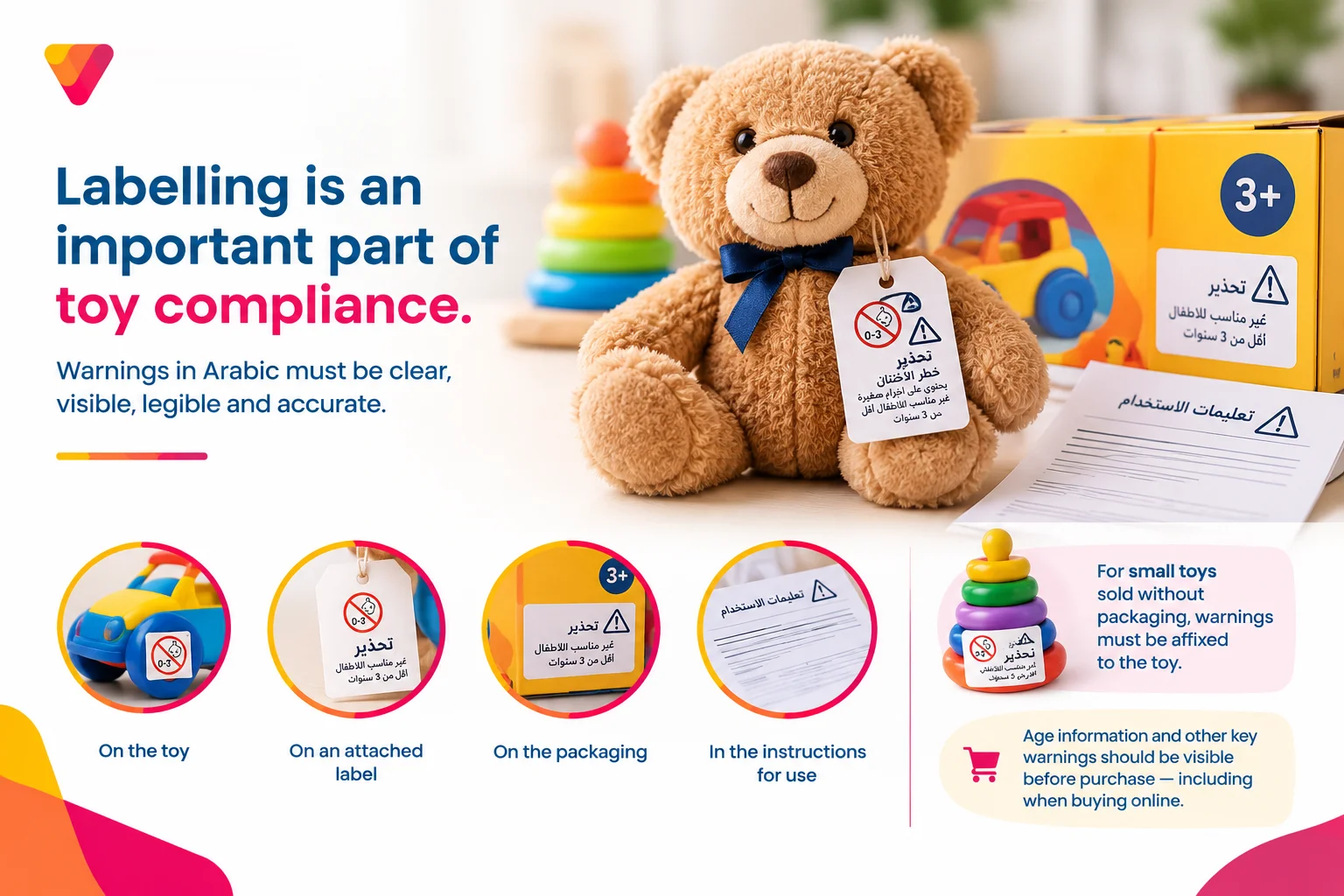
Labelling is an important part of toy compliance. The GCC Technical Regulation requires warnings to be provided in Arabic in a clearly visible, legible, understandable and accurate manner. Depending on the toy, warnings may appear:
- On the toy
- On an attached label
- On the packaging
- In the instructions for use
For small toys sold without packaging, appropriate warnings must be affixed to the toy. Warnings that influence the purchasing decision, such as minimum or maximum age information, must be visible to consumers before purchase, including when the product is purchased online.
Common Toy Warnings
The regulation contains specific warnings for different categories of toys. Examples include warnings relating to:
- Toys unsuitable for children under 36 months
- Activity toys
- Functional toys
- Chemical toys
- Certain skates, scooters and toy bicycles
- Aquatic toys
- Toys contained in food
- Imitation protective masks and helmets
- Certain toys attached to cradles, cots or perambulators
The exact warning depends on the characteristics and intended use of the product. Manufacturers should not simply add a generic “Not suitable for children under 3 years” statement to every product. The warning must correspond to the applicable requirements and the actual risks and intended use of the toy.
Arabic Instructions and Safety Information
For toys imported into the GCC market, the regulation places specific responsibilities on importers regarding instructions and safety information. The importer must ensure that the toy is accompanied by instructions and safety information in Arabic. This is particularly important for products that require:
- Assembly
- Adult supervision
- Specific operating instructions
- Safety precautions
- Maintenance
- Age restrictions
- Chemical handling precautions
For certain toys, instructions form an important part of demonstrating that the product can be used safely.
What Is the G-Mark for Toys?
The G-Mark, also referred to in the regulation as the Gulf conformity marking/GC marking, indicates conformity with applicable Gulf technical regulations. Under the GCC Technical Regulation on Children Toys, toys made available on the market must bear the GC marking and meet the applicable requirements related to that marking.
SASO’s current service information also lists a Gulf Conformity Mark for Toys (G-Mark) service.
This is an important distinction: G-Mark is not simply another name for a generic SASO certificate. For toys, the applicable GCC conformity framework determines the conformity assessment and marking requirements.
Is SABER Required for Toys in Saudi Arabia?
SABER is Saudi Arabia’s electronic platform for product registration, conformity-related processes and shipment certification. SABER describes its role as facilitating product registration, conformity certificates and shipment certificates for products entering the Saudi market.
For commercial products subject to technical regulations, the SABER process can involve:
- Product registration
- Product conformity assessment
- Registration of the relevant conformity certificate
- Shipment certificate procedures for individual shipments
SABER’s current information states that importers can register product conformity certificates for commercial products and obtain shipment certificates. The exact SABER workflow depends on the product classification, applicable technical regulation and conformity route.
For toys, the important point is that SABER should be considered part of the Saudi market-entry process, while the underlying toy safety and conformity requirements come from the applicable technical regulation.
G-Mark vs SABER at a Glance
| Aspect | G-Mark / GC Marking | SABER |
|---|---|---|
| What it is | Gulf conformity marking | Saudi electronic platform |
| Main purpose | Indicates conformity with applicable Gulf technical regulations | Product registration, conformity certificate registration and shipment certification |
| Applies to | Toys made available on the GCC market | Products entering the Saudi market |
| Source of requirements | GCC Technical Regulation on Children Toys | Saudi market-entry process, based on the applicable technical regulation |
Toy Conformity Assessment Process
A typical compliance process can be structured in ten steps.
Step 1: Identify the Product
Start with the actual toy rather than the marketing name. Review:
- Product type
- Intended use
- Age group
- Materials
- Components
- Packaging
- Electrical features
- Chemicals
- Accessories
- Intended market
This helps establish which requirements apply.
Step 2: Determine the Applicable Regulation and Standards
The next step is to identify the applicable Gulf technical regulation and relevant standards. The GCC toy regulation provides the mandatory safety framework, while applicable Gulf standards can provide a route for demonstrating conformity with the requirements they cover.
Step 3: Conduct a Safety and Risk Assessment
The manufacturer must identify relevant hazards. The regulation specifically refers to chemical, physical, mechanical, electrical, flammability, hygiene and radioactivity hazards. The assessment should be based on the actual product and foreseeable use.
Step 4: Perform the Required Testing
Testing should be selected based on the applicable requirements. Depending on the toy, this may include:
- Physical and mechanical tests
- Flammability tests
- Chemical testing
- Electrical safety testing
- Other applicable assessments
The GSO notified-body directory provides examples of toy conformity scopes covering physical/mechanical, flammability and warning requirements.
Step 5: Prepare the Technical Documentation
The technical file is an important part of the conformity process. The regulation states that technical documentation should contain the information necessary to assess conformity and, where applicable, includes:
- General description of the toy
- Design and manufacturing information
- Components and materials
- Circuits, where relevant
- Safety data sheets for chemicals used
- Manufacturing and storage locations
- Applicable Gulf standards
- Design calculations and examinations
- Conformity assessment procedure
- Test reports
- Risk analysis and assessment
The regulation also specifies requirements concerning the language and availability of the technical documentation.
Step 6: Complete the Applicable Conformity Assessment
The regulation establishes conformity assessment procedures for manufacturers and, under specified circumstances, importers. Where type examination is applicable, a notified conformity assessment body performs the relevant examination and testing and issues a type examination certificate where the requirements are met.
The regulation also requires third-party conformity assessment bodies used for the relevant procedure to be notified in accordance with the applicable Gulf requirements.
Step 7: Issue the Declaration of Conformity
The manufacturer conformity declaration confirms that the applicable requirements have been demonstrated. The regulation requires the manufacturer declaration to be prepared in Arabic and English and to identify the applicable conformity assessment procedure.
Step 8: Apply the Conformity Marking
Once the applicable requirements have been fulfilled, the required Gulf conformity marking is applied in accordance with the applicable rules. The toy regulation states that toys made available on the market must bear the GC marking.
Step 9: Complete the Saudi SABER Process
For products entering the Saudi market, the relevant product and conformity information is handled through SABER as applicable. SABER currently provides services for product registration, conformity certificate registration and shipment certificates.
Step 10: Maintain Compliance After Market Entry
Compliance does not end when a shipment clears customs. Manufacturers and importers have continuing responsibilities under the toy regulation. For example, importers are required to take corrective action when they have reason to believe that a toy placed on the market does not comply, including withdrawal or recall where appropriate.
The regulation also requires specified conformity and technical documentation to be retained for 10 years after the toy has been placed on the market.
Process Summary
| Step | Action | Key Output |
|---|---|---|
| 1 | Identify the product | Product profile (type, age group, materials, features) |
| 2 | Determine regulation and standards | Applicable requirements list |
| 3 | Safety and risk assessment | Hazard and exposure assessment |
| 4 | Required testing | Test reports |
| 5 | Technical documentation | Complete technical file |
| 6 | Conformity assessment | Type examination certificate, where applicable |
| 7 | Declaration of conformity | Arabic and English declaration |
| 8 | Conformity marking | GC marking applied |
| 9 | SABER process | Registered product and conformity data, shipment certificate |
| 10 | Post-market compliance | Records kept for 10 years, corrective action procedures |
What Documents Are Needed for Toy Compliance?
The exact document package depends on the product and conformity route, but manufacturers and importers should be prepared to provide relevant technical and conformity evidence. This may include:
- Product description
- Product photographs
- Product specifications
- Bill of materials
- Component information
- Material information
- Safety data sheets for relevant chemicals
- Risk assessment
- Applicable standards
- Test reports
- Technical drawings
- Manufacturing information
- Instructions and safety information
- Arabic warnings
- Declaration of conformity
- Type examination documentation, where applicable
- Other evidence required by the applicable conformity assessment procedure
The GCC regulation specifically describes the contents of technical documentation and requires sufficient information to demonstrate conformity.
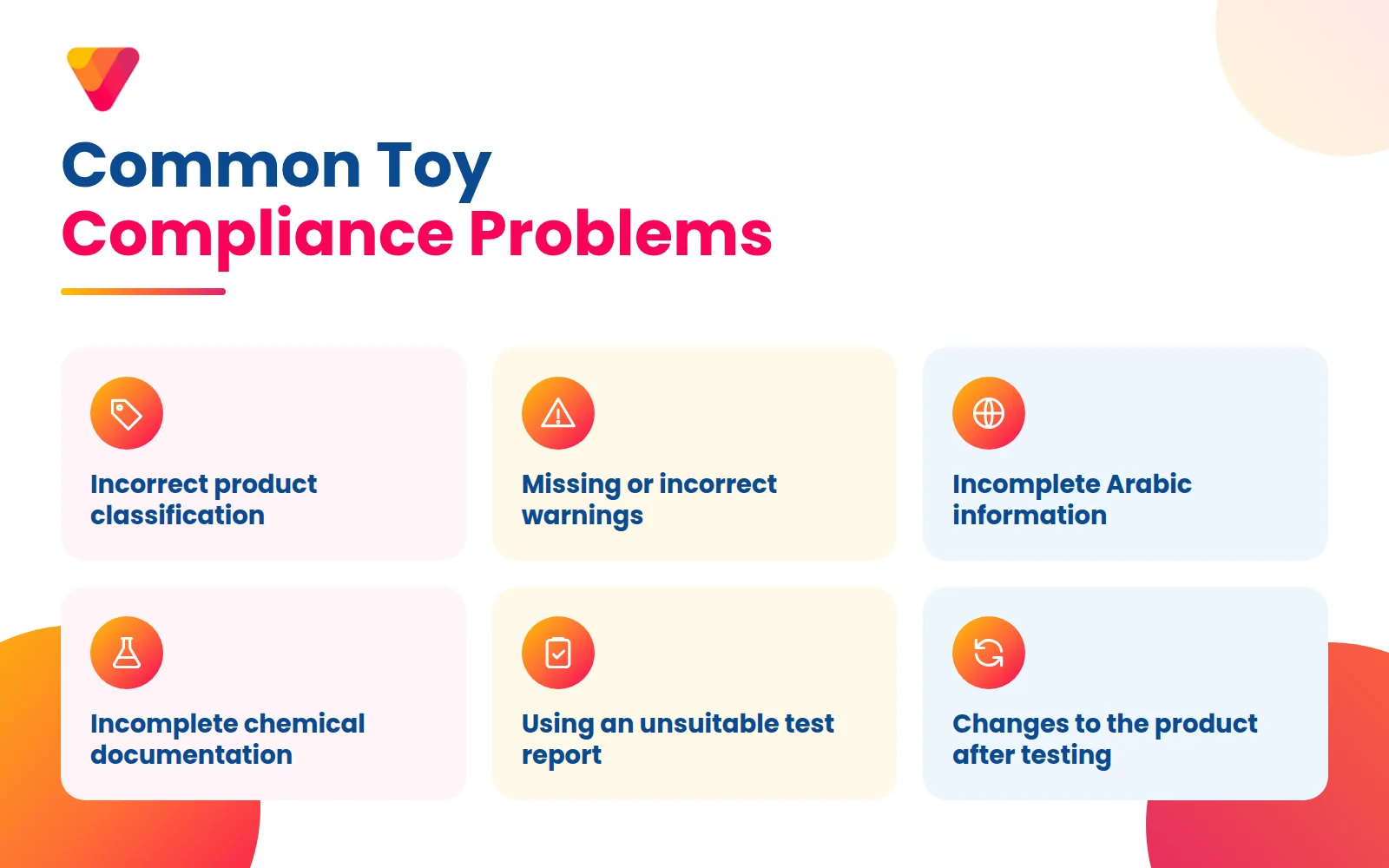
Common Toy Compliance Problems
Toy shipments can encounter compliance problems when manufacturers treat regulatory compliance as a documentation exercise instead of a product-safety process.
| Common Problem | Why It Matters |
|---|---|
| Incorrect product classification | A children’s product may not necessarily fall within the toy regulation, while a product marketed under a different category may still meet the regulatory definition of a toy. |
| Missing or incorrect warnings | Warnings must correspond to the product and applicable requirements. Age restrictions and other purchasing-related warnings also need to be visible before purchase, including online. |
| Incomplete Arabic information | Instructions and safety information required for toys must be available in Arabic as required by the regulation. |
| Incomplete chemical documentation | Chemical composition and migration requirements can be significant, particularly for toys intended for young children or toys that can be placed in the mouth. |
| Using an unsuitable test report | A test report should correspond to the actual product, applicable requirements and relevant standards. A generic report for a similar product should not automatically be treated as evidence of compliance. |
| Changes to the product after testing | Changes to materials, components or manufacturing processes can affect conformity. A type examination certificate should be reviewed when relevant changes occur and, in any case, every five years. |
Toys Compliance Checklist for Saudi Arabia
Before exporting toys to Saudi Arabia, manufacturers and importers can use the following high-level checklist:
| Compliance Area | What to Check |
|---|---|
| Product classification | Confirm whether the product falls within the toy regulation |
| Intended age | Verify age group and applicable restrictions |
| Risk assessment | Identify physical, mechanical, chemical, electrical and other relevant hazards |
| Testing | Identify and complete applicable tests |
| Chemical safety | Review applicable substance and migration requirements |
| Mechanical safety | Check small parts, stability, strength and injury hazards |
| Flammability | Determine applicable flammability requirements |
| Electrical safety | Assess electrical features where applicable |
| Warnings | Check product-specific warnings |
| Arabic information | Provide required Arabic warnings, instructions and safety information |
| Technical file | Compile design, materials, risk assessment and test evidence |
| Declaration | Prepare the applicable declaration of conformity |
| G-Mark | Complete the applicable Gulf conformity-marking requirements |
| SABER | Complete the applicable Saudi product/conformity and shipment procedures |
| Post-market control | Maintain records and procedures for corrective action, withdrawal or recall |
Do All Toys Need the Same Tests?
No. This is one of the most important points for manufacturers and importers.
A stuffed toy, a plastic building set, a chemical experiment kit and a battery-powered interactive toy can present very different hazards. The GCC regulation therefore requires manufacturers to assess the hazards associated with the particular toy.
The appropriate test program should be established after reviewing the product’s:
- Design
- Materials
- Components
- Intended age
- Intended use
- Functions
- Electrical characteristics
- Chemical content
- Applicable warnings
- Relevant standards
This approach helps avoid both under-testing and unnecessary testing.
How Verger Group Can Support Toy Compliance in Saudi Arabia
For companies planning to export toys to Saudi Arabia, compliance can involve several connected activities, from product assessment and testing through conformity assessment and market-entry documentation.
Verger Group can support businesses with relevant testing, inspection, certification and conformity assessment services, depending on the product, applicable requirements and the scope of the requested service. A typical project may involve:
Product review → Applicable requirements → Testing → Technical documentation → Conformity assessment → G-Mark requirements → SABER process → Shipment compliance
Because requirements can depend on the specific toy, HS code, product characteristics and applicable technical regulations, the compliance route should be confirmed for each product before shipment.
Frequently Asked Questions
Is a SASO certificate required for toys in Saudi Arabia?
Toy compliance should not be described simply as obtaining a generic SASO certificate. Toys are subject to the applicable GCC Technical Regulation on Children Toys, including its conformity assessment and Gulf conformity-marking requirements. In Saudi Arabia, the relevant product and conformity processes are handled through SABER as applicable.
Do toys need the G-Mark?
Toys covered by the GCC Technical Regulation on Children Toys must bear the applicable Gulf conformity marking when made available on the market. For businesses importing or selling toys in Saudi Arabia, toys compliance in Saudi Arabia includes meeting the applicable technical requirements and obtaining the required conformity documentation and marking. SASO also lists a Gulf Conformity Mark for Toys service.
Are toy tests mandatory in Saudi Arabia?
For toys compliance in Saudi Arabia, the applicable conformity assessment requires evidence demonstrating compliance with the relevant safety requirements. The exact testing depends on the toy and applicable requirements; the regulation requires a safety assessment covering relevant chemical, physical, mechanical, electrical, flammability, hygiene and radioactivity hazards.
Do toy labels need to be in Arabic?
Yes, toys compliance in Saudi Arabia includes specific Arabic language requirements where the regulation requires warnings and safety information. Warnings must be clearly visible, legible, understandable and accurate, while instructions and safety information must be provided in Arabic as specified by the applicable regulation.
Do toys for children under three have additional requirements?
Yes. The regulation contains specific requirements for toys intended for children under 36 months, including requirements concerning detachable parts and risks of swallowing or inhalation, as well as specific chemical requirements.
Is SABER the same as G-Mark?
No. They serve different functions. The G-Mark/GC marking relates to conformity with applicable Gulf technical regulations, while SABER is Saudi Arabia’s electronic platform for product registration, conformity-related processes and shipment certification.
How long should toy compliance documents be retained?
The GCC toy regulation requires specified conformity and technical documentation to be kept available to authorities for 10 years after the product has been placed on the market.
Can the same test report be used for every toy model?
Not automatically. The suitability of test evidence depends on the product, its design, materials, components, applicable requirements and conformity assessment procedure. Product changes can also affect conformity.
What should I do before shipping toys to Saudi Arabia?
Start by confirming the product classification and applicable technical requirements. Then determine the necessary testing and conformity assessment, prepare the technical documentation and Arabic information, complete the applicable Gulf conformity-marking requirements, and complete the relevant SABER procedures before shipment.
Read full article on Top 10 products Saudi Arabia Imports
Conclusion
Toys compliance in Saudi Arabia requires a product-specific approach. Manufacturers and importers should not treat compliance as simply obtaining a certificate. The process begins with understanding whether the product falls within the GCC Technical Regulation on Children Toys and then evaluating its safety risks, applicable standards, testing requirements, warnings, documentation and conformity assessment route.
For Saudi market entry, the compliance process may ultimately connect toy testing, technical documentation, conformity assessment, G-Mark requirements and SABER procedures.
Because toy requirements can vary significantly according to product design, materials, age group and intended use, businesses should confirm the applicable requirements before manufacturing or shipping.
Planning to export toys to Saudi Arabia? Contact Verger Group for toy testing, inspection, certification, conformity assessment and SASO certificate services to help meet the applicable Saudi and GCC requirements for your products.