
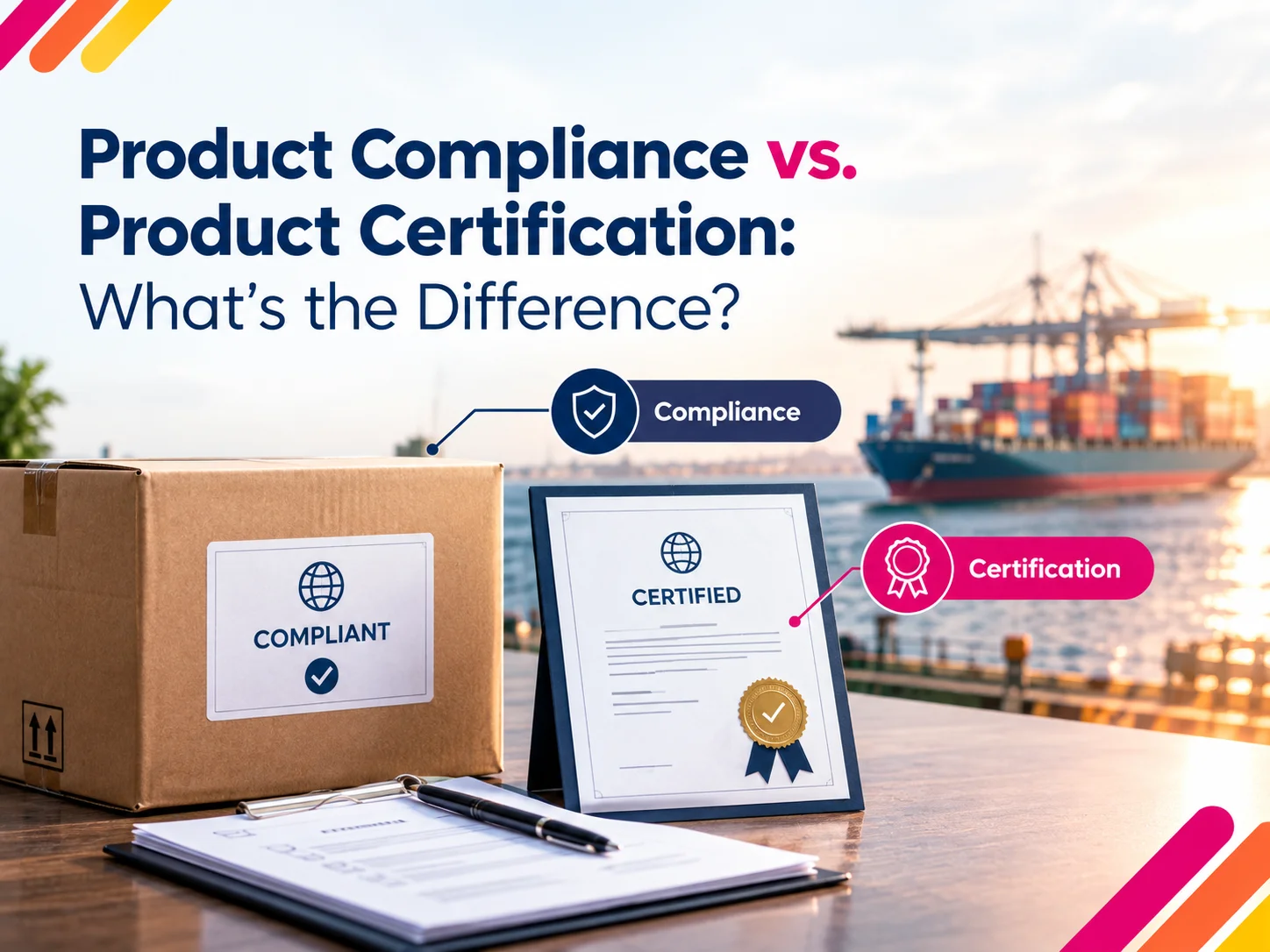
Our product is compliant with SASO standards” and “our product is SASO certified” sound like the same claim. They are not — and the difference between them is exactly where many shipments get held at customs, even when the exporter genuinely believed they had done everything right.
This guide explains product compliance vs product certification, what separates the two, why customs authorities and regulators may treat them differently, and what it actually takes to move from compliance to certification.
Quick answer: Compliance is a claim that a product meets applicable requirements — often self-declared. Certification is documented proof, issued by an independent accredited body, that the claim has been verified. A product can be compliant without being certified, but in regulated markets, certification may be required for market entry or customs clearance.
What Is Product Compliance?
Product compliance means a product meets the technical, safety, or quality requirements set by a relevant standard or regulation. Critically, compliance on its own is typically a self-declared status — the manufacturer or supplier states that the product meets the requirements, based on their own testing, design records, or internal review.
This doesn’t mean the claim is false. Many compliant products genuinely do meet every requirement. But compliance alone doesn’t show who verified that, what process was used, or whether an independent party checked the claim at all.
What Is Product Certification?
Product certification goes a step further: an independent, accredited third party — a Conformity Assessment Body (CAB) — evaluates and tests the product directly against the full requirements of a standard, and issues a certificate confirming the result.
This typically involves several verification steps rather than a single check:
- Product testing against the specific standard’s technical criteria
- Review of technical documentation and manufacturing records
- In many schemes, an on-site factory or facility inspection
- Issuance of a certificate tied to that specific product, model, or shipment
Because an accredited body — not the manufacturer — is making the determination, certification carries a different legal and commercial weight. It’s why customs authorities in regulated markets ask for a certificate, not a compliance statement.
Product Compliance vs Product Certification: Key Differences at a Glance
| Aspect | Product Compliance | Product Certification |
| Who confirms it | The manufacturer or supplier (self-declared) | An independent, accredited Conformity Assessment Body |
| Proof document | A compliance statement or declaration | A formal certificate tied to the product/shipment |
| Verification depth | Internal testing or review, scope varies | Standardized testing, documentation review, often facility inspection |
| Legal/customs standing | Often not sufficient alone for regulated imports | Typically required for customs clearance in regulated markets |
| Validity | No fixed renewal cycle | Usually time-bound, with defined renewal requirements |
| Example | “This product meets SASO technical requirements” | A SASO/SABER Certificate of Conformity issued by an approved CAB |
Can a Product Be Compliant But Not Certified?
Yes — and this is exactly where many exporters run into trouble. A product can be genuinely, technically compliant with every relevant standard and still get held at a border, because compliance was never independently verified and documented in the form the destination market requires.
This is one of the most common — and costly — misunderstandings in cross-border trade: believing a product is “ready” because it meets a standard, without realizing the destination market requires proof from an accredited certification body, not a self-declaration.
Why This Distinction Matters for Exporters to Saudi Arabia and the GCC?
Markets with strict conformity regimes — Saudi Arabia’s SASO/SABER program among them — don’t accept a compliance statement in place of certification for regulated product categories. A shipment needs a Certificate of Conformity issued by a notified, accredited Conformity Assessment Body before it can clear customs.
This is also why the distinction between an accredited certification body and a facilitator or consultant matters: only an accredited CAB can actually perform the verification that produces a valid certificate. A facilitator can help manage the paperwork and process, but the underlying certification still has to come from an accredited body.
Common Misconceptions
• “My product passed internal testing, so it’s certified.” — Internal testing supports a compliance claim, not a certification, unless an accredited body performed or verified it.
• “One certificate covers every shipment of this product forever.” — Most certification schemes tie validity to a fixed period and, in many cases, to individual shipments or batches.
• “Compliance and certification are just different words for the same paperwork.” — They represent different levels of verification, and regulators treat them as materially different.
Frequently Asked Questions
Is a compliance declaration ever enough for customs clearance?
In some unregulated categories, yes. But for the specific regulated product categories under schemes like SASO/SABER, customs authorities require a certificate from an accredited Conformity Assessment Body, not a self-declared compliance statement.
Does certification replace the need for compliance?
No — certification confirms compliance has been independently verified. A product still needs to genuinely meet the underlying standard; certification is the documented proof of that, not a substitute for it.
Who is allowed to issue a certification?
Only an accredited Conformity Assessment Body — one recognized under the relevant accreditation scheme (such as ISO/IEC 17065) and, where required, notified by the destination market’s regulator — can issue a valid certificate.
How do I know if my product needs certification or just compliance?
Understanding product compliance vs product certification depends on the destination market and product category. Regulated products in markets like Saudi Arabia, Qatar, and Egypt may require certification, while other products may only require applicable compliance documentation. Checking the specific technical regulation for your product and destination is the most reliable way to confirm.
Need compliance turned into certification?
VERGER Group is an ISO/IEC 17065 and ISO/IEC 17020 accredited Conformity Assessment Body, notified for SASO/SABER certification across Saudi Arabia, Qatar, and Egypt — turning a compliant product into a certified, customs-ready shipment.
Explore SASO/SABER Certification Services: https://verger-group.com/saso-certification-saber/