
SASO’s Technical Regulation for Paints (Dyes) and Varnishes (document 03-03-16-155) is the rulebook for every paint or varnish sold in Saudi Arabia. In practice, compliance with the technical regulations for paints and varnishes means meeting the listed product standards, staying within chemical limits, labelling correctly, and holding a certificate of conformity from a SASO-accepted certification body.
Since 1 October 2026, covered paints have also needed SASO’s environmental performance label before a Product Certificate of Conformity (PCoC) can be issued. Understanding the technical regulations for paints and varnishes is essential for manufacturers, importers, and suppliers seeking to comply with Saudi market requirements.
Why Saudi Arabia Regulates Paints and Varnishes?
Paints release solvents and may contain harmful metals, so the Saudi Standards, Metrology and Quality Organization (SASO) treats them as a health, safety and environmental matter. The regulation sets the essential requirements a product must satisfy and the conformity route a supplier must follow, while keeping with the WTO principle that technical rules should not become trade barriers.
The version in force is the second edition, Amendment 2, published in the Official Gazette on 4 November 2022. It replaced an earlier update that SASO’s board approved in November 2017 and that was published in January 2018. The rules apply at every stage of the supply chain within the Kingdom. Only the Arabic text has legal force, so whenever the English translation differs, follow the Arabic.
What the Regulation Covers?
The scope is paints and varnishes used in homes, commercial buildings and public facilities, as listed in the regulation’s annexes. It sits alongside, and does not replace, other Saudi rules on transport, storage, handling, safety and the environment.
Key Terms
| Term | Plain-English meaning |
|---|---|
| Paint | Solid particles suspended in a liquid that dries into a film bonded to the surface |
| Varnish | A clear, colour-free coating of oils, solvents and polymers that protects and adds gloss |
| Emulsion paint | Water-dispersed coating built on a resin and colloidal binder |
| Water-based paint | Paint that uses water as the solvent |
| Oil-based paint | Paint using petroleum or non-petroleum solvents with resin binders |
| VOC | A carbon-based compound that boils below 250 °C at normal atmospheric pressure |
| VOC content | Grams of VOC per litre of ready-to-use product, excluding material that reacts into the dried film |
Who Is Legally Responsible?
The duty falls on the supplier that places the product on the Saudi market:
- The manufacturer, if it is based in Saudi Arabia
- The manufacturer’s authorised agent in the Kingdom, if the manufacturer is overseas
- The importer, if there is no agent
- Anyone else in the supply chain whose activity changes the product’s characteristics
Technical Requirements
1. Product Standards
Annex 2 lists 56 standards covering test methods and product specifications. SASO notes the list is under review and suppliers must apply the latest edition of each. Examples:
| Product | SASO standard |
|---|---|
| Emulsion paints | SASO 470 |
| Emulsion primers | SASO 2060 |
| Alkyd paints (gloss, semi-gloss, matt) | SASO 2881 |
| Water-based texture paints | SASO 2626 |
| Water-based roof paints | SASO 2627 |
| Solvent-based acrylic paints | SASO 2705 |
| Nitrocellulose paints and putty | SASO 2701 to 2704 |
| Polyurethane paints | SASO 2831 to 2834 |
| Wood varnishes | SASO 2838 |
| Epoxy primer and clear sealer | SASO 2852 and 2853 |
| Intumescent fire-protection coatings | SASO 2981 and 2982 |
| Road marking paints and glass beads | SASO 819 and SASO 944 |
2. Environmental Performance Limits
Annex 1 defines two classes: Class A (stronger environmental performance) and Class B. Maximum VOC content in g/L of ready-to-use product:
| Product | Class A | Class B |
|---|---|---|
| Interior matt paints and ceiling paints | 30 | 50 |
| Surface layer paints (single coat or over primer) | 150 | 150 |
| Other water-based paints | 100 | 150 |
| Oil paints and varnishes | 380 | 500 |
VOCs are tested under ISO 11890-1 or ISO 11890-2. Other chemical limits:
- Heavy metals: no mercury, lead, cadmium, hexavalent chromium, arsenic, antimony, tributyltin or triphenyltin intentionally present. Lead is capped at 0.009% and total heavy metals at 0.01% (ISO 3856 series and ISO 2590).
- Aromatic hydrocarbons: up to 0.1% in interior matt and ceiling paints, 1.0% in surface layer paints, and 5.0% in other water-based paints, oil paints and varnishes (ASTM D3257).
- Halogenated hydrocarbons: the English text states 220 ppm while the Arabic text states 250 ppm. Work to the stricter 220 ppm (ASTM D4457).
- Formaldehyde: products must be formaldehyde-free, supported by ASTM D6191 test reports.
A manufacturer holding an ISO 14001 environmental management certificate is treated as having an effective environmental management system.
3. Packaging and Quantity
- Containers free from lead and other heavy metals
- Recycling symbol on plastic containers
- Tight, leak-proof closure with no reaction between pack and contents
- Quantity declared in SI units, with containers meeting OIML R 87
Labelling Requirements
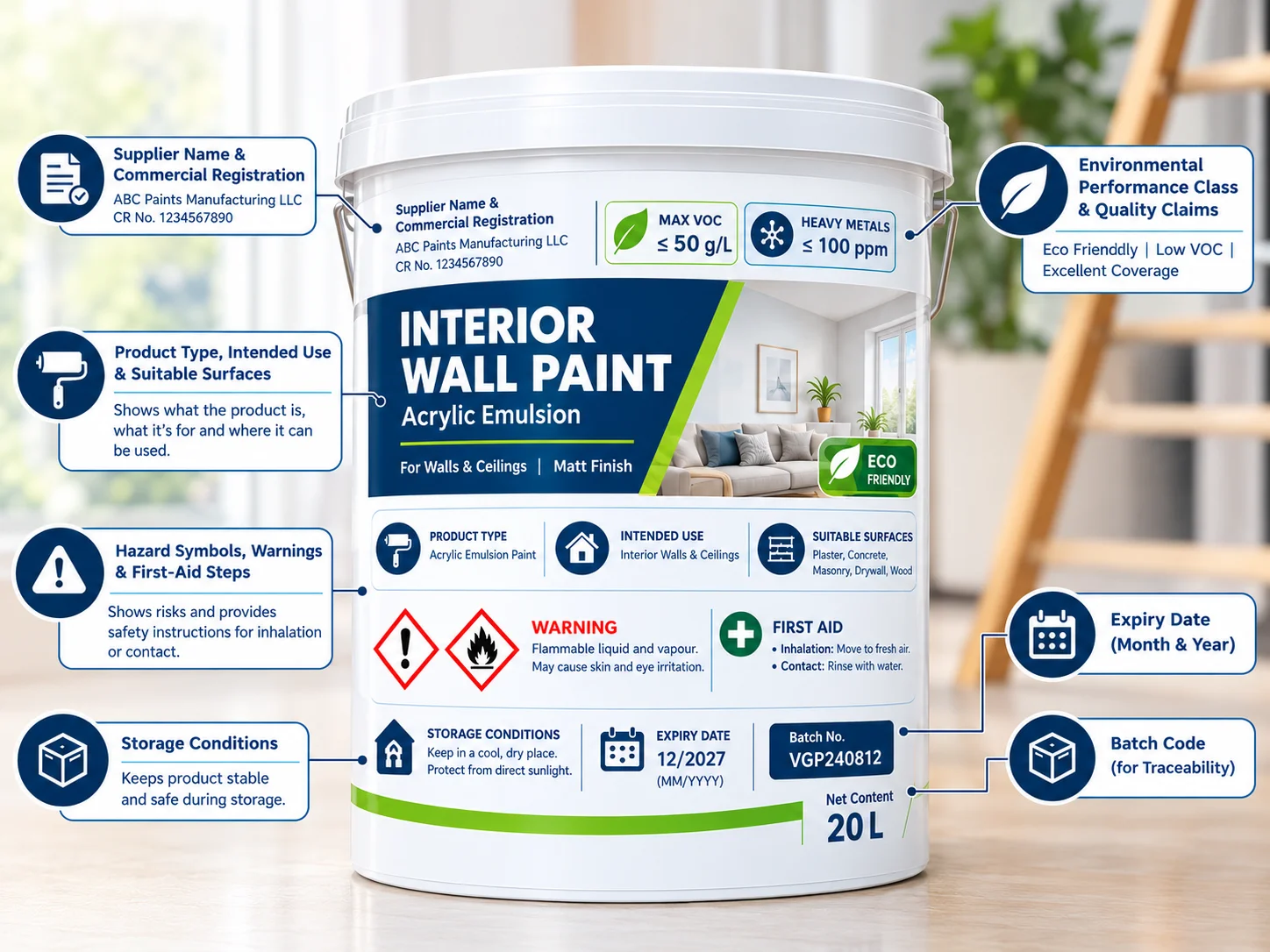
Labels must be accurate, verifiable, and aligned with the regulation, the relevant product standard and SASO GSO 1810 (labelling of chemical products). Each label should carry:
- Supplier name and commercial registration
- Maximum VOC and heavy metal levels of the ready-to-use product
- Environmental performance class and quality claims such as flow and coverage
- Product type, intended use and suitable surfaces
- Expiry date (month and year) or a “use before” statement
- Hazard symbols, warnings and first-aid steps for inhalation or contact
- Storage conditions
- A batch code on every container for traceability
Images and wording must also respect public order, public morals and Islamic values in the Kingdom.
Conformity Assessment: Type 3 Certification
Suppliers must obtain a certificate of conformity from a SASO-accepted body under Type 3 of ISO/IEC 17067. Type 3 looks at the manufacturer’s production quality control, not just a sample of the product.
- Apply to a certification body of your choice, with company details, proof the manufacturer is licensed in its home country, a declaration that no other body has been approached, product category information, safety management system documents, and technical documents including the Type Approval Certificate.
- Implement a documented product safety management system covering production, final inspection and testing.
- Audit: the body assesses that system, including a factory visit by a team that includes a technical expert, and approves it for three years.
- Surveillance: periodic audits follow, with the option of unannounced visits and tests. Planned system changes must be reported.
- Certificate: issued while the approval remains valid.
- Declaration of conformity: the supplier issues one per approved type and keeps it, with system records, approved amendments and the body’s decisions, available to regulators for at least 10 years after market placement.
Every product also needs a technical file containing the declaration of conformity (annex form), a risk assessment and the country of origin, supplied to regulators on request.
The Environmental Performance Label (Mandatory from 1 October 2026)
SASO announced that the environmental performance label became compulsory on 1 October 2026 for paints and varnishes in Annex 1: interior matt and ceiling emulsions, surface layer paints, other water-based paints, and oil paints and varnishes. Certification bodies cannot issue a PCoC without it, and non-compliant products face regulatory action. Bureau Veritas had earlier told suppliers they could apply voluntarily to ease the transition.
How it works?
- The product must already hold a certificate of conformity from a SASO-accepted body
- Each product model needs its own application
- Apply through SASO’s Maneh portal under certification services
- The license runs for one year, with renewal requested at least one month before expiry
- Fees: SAR 500 application, SAR 500 document review, and a label license that is free for Class A and SAR 500 for Class B
- The label must be visible, permanently attached, and printed to the annex design, on both product and packaging
- You may advertise the license but must not use the label misleadingly
Fees and rules can change, so confirm with SASO or your certification body, and submit the label application well before your next PCoC request.
Port Checks, Market Surveillance and Penalties
- Border and factory checks: officials verify conformity procedures, accompanying technical documents and correct label placement
- Sampling: random samples go to laboratories at the importer’s expense
- Non-conforming goods: can be pulled from warehouses and shops, re-exported or destroyed at the supplier’s cost
- Prohibited activities: making, importing, displaying, selling and even advertising non-conforming products
- Typical grounds for non-conformity: missing or incorrect conformity or Saudi Quality marks, no certificate or declaration, incomplete technical files, missing label data or safety instructions
- Penalties: certificate cancellation and action under the Anti-Commercial Fraud Law, without prejudice to stricter laws
HS Codes for Paints and Related Products
The annex groups products by customs heading, but the SABER platform holds the current, certified product and HS code list. Since 1 January 2026, SABER has used 12-digit codes aligned with the Saudi customs tariff.
| HS heading | Products |
|---|---|
| 3204 | Synthetic organic colouring matter (disperse, acid, basic, direct, vat, reactive dyes) and pigments |
| 3205 | Colour lakes and preparations |
| 3206 | Other colouring matter, including titanium dioxide, chromium and zinc sulphide pigments |
| 3207 | Prepared pigments, opacifiers, colours and liquid lustres |
| 3208 | Paints and enamels |
| 3209 | Acrylic or vinyl paints and enamels in an aqueous medium |
| 3814 | Thinners, paint removers and organic composite solvents |
Search your product on SABER using the full 12-digit code to see which regulation and certificate type apply, and refresh any older registration with an outdated code.
Supplier Compliance Checklist
- Confirm the product type and 12-digit HS code on SABER
- Match the product to the Annex 2 standards
- Test VOCs, heavy metals, aromatics, halogenated hydrocarbons and formaldehyde by the prescribed methods
- Design the label to Article 5 and SASO GSO 1810
- Check packaging for lead-free materials, recycling symbol, sealing and SI units
- Set up a documented product safety management system
- Apply for Type 3 assessment and the factory audit
- Assemble the technical file
- Apply for the environmental performance label license before the next PCoC request
- Register the importer and product on SABER and obtain shipment certificates
See our related guides: How to Get a SABER Certificate for Saudi Arabia and Why Saudi Shipments Get Delayed.
Common Compliance Gaps
- No environmental label on covered paints
- Labels lacking batch code, expiry date, VOC or heavy metal data, or hazard warnings
- Test reports using methods other than those named in the annex
- Outdated standard editions
- Missing declaration of conformity or risk assessment
- HS code or product type inconsistent with the standard used
- Absent conformity marks or Saudi Quality Mark where required
How Verger Group Can Help?
Verger Group is an ISO/IEC 17065 accredited certification body, SASO-notified and listed on SABER. Share your product list and labels and our team will confirm which parts of the regulation apply to your range and which documents are still outstanding.
Frequently Asked Questions
Is certification compulsory for paints and varnishes in Saudi Arabia?
Yes. The supplier placing the product on the market must hold a certificate of conformity from a SASO-accepted body.
Which conformity assessment type applies?
Type 3 under ISO/IEC 17067, which evaluates the manufacturer’s production quality control and includes a factory audit.
Which standards apply to my paint?
The Annex 2 standards for your product type, plus the Annex 1 environmental limits, always using the latest editions.
What are the heavy metal limits?
Lead up to 0.009%, total heavy metals up to 0.01%, and no mercury or the other listed metals.
Are a batch code and expiry date required?
Yes. Every container needs a batch code, and the expiry date must show month and year.
How long must technical documents be kept?
At least 10 years after the product is placed on the market.
Who pays for port sampling?
The importer.
Is the environmental performance label mandatory?
Yes, from 1 October 2026 for the Annex 1 paints and varnishes. No PCoC can be issued without it.
What are the VOC limits?
For interior matt and ceiling paints: 30 g/L (Class A) and 50 g/L (Class B). Other categories are higher, as shown above.
How do I apply for the label?
Through SASO’s Maneh portal under certification services, with a separate application per product model and a one-year licence.
This guide is for general information. Always check the current Arabic text of the regulation and confirm requirements with SASO or your certification body before shipping.